
Whose name is on the power contract?
Meta's name is not on the contract that decides whether Louisiana gets seven new gas plants. A company called Evest LLC is.
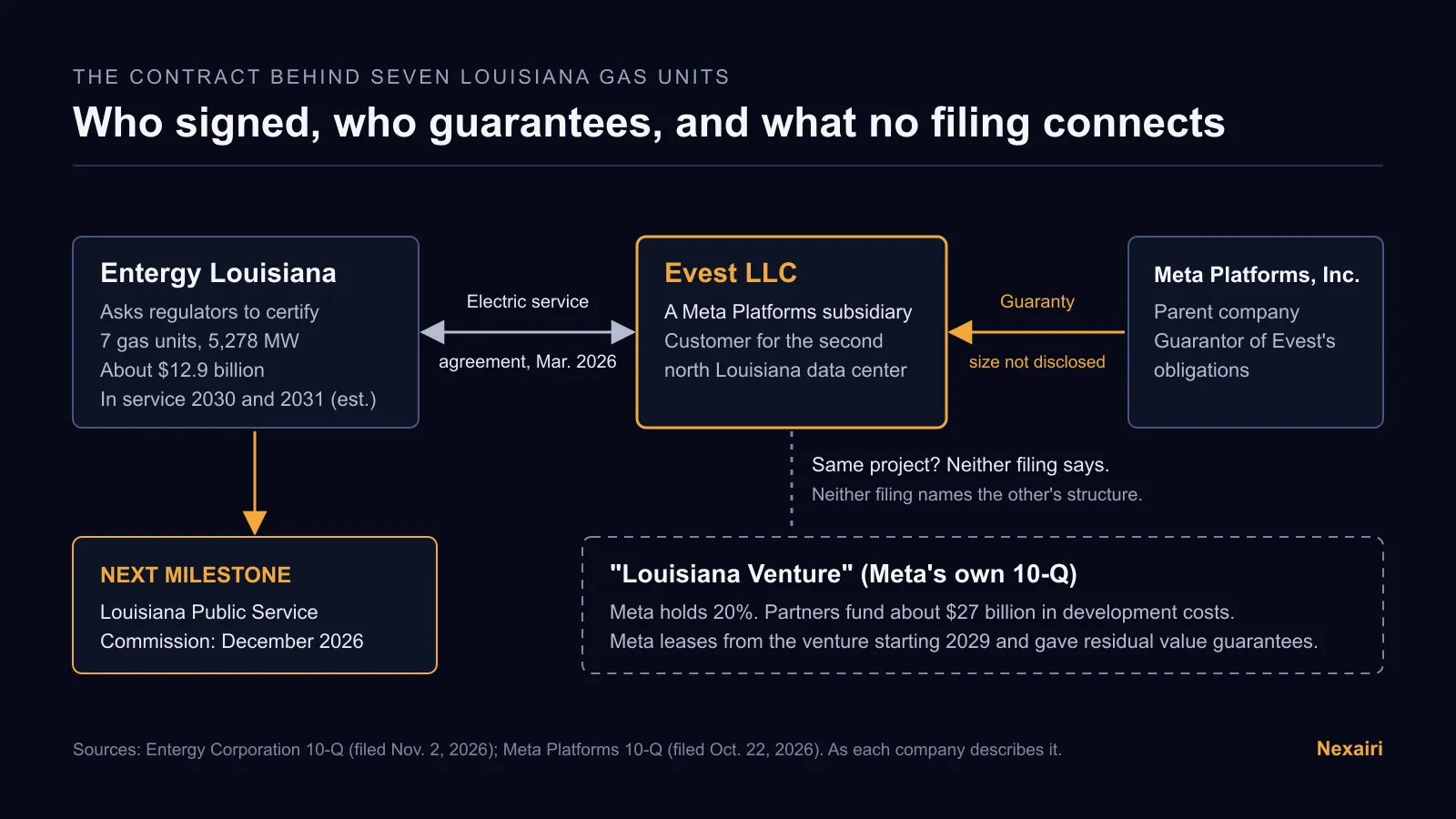
Entergy Louisiana's quarterly report says it signed an electric service agreement in March 2026 with Evest, "a subsidiary of Meta Platforms, Inc." The agreement covers "a second new data center to be developed by Evest in north Louisiana." The same passage goes back to an October 2024 application for a first data center. Entergy says a Meta subsidiary is developing that one too, and that an electric service agreement was "previously executed."
Press coverage calls the Louisiana campus Hyperion, in Richland Parish, and ties all ten of Meta's planned gas plants to it. Entergy's filing does not use that name. It describes two data centers and says "the customer" and "north Louisiana." We will follow the filing, because it is the document with the contract terms.
What is Entergy asking regulators to approve?
Entergy wants Louisiana regulators to certify seven new gas units totaling 5,278 megawatts at about $12.9 billion. Four would sit near the customer's site.
The Louisiana Public Service Commission has to approve them. The units are combined cycle combustion turbines, the kind that burn gas to spin a turbine and then reuse the waste heat for a second round of power.
| Item | What Entergy's filing says |
|---|---|
| Size | Seven units totaling 5,278 MW |
| Cost | About $12.9 billion |
| Location | Four near the customer site (Richland Parish Units 1-4). Three near the Big Cajun site in Pointe Coupee Parish |
| In service | Estimated dates in 2030 and 2031 |
| Also requested | Three battery storage systems and a 500 kV transmission line estimated at $1.4 billion |
Divide the cost by the size and you get about $2.44 million per megawatt ($12.9 billion over 5,278 MW). That figure comes with a catch. The sentence ties the $12.9 billion to the seven units and does not say whether the batteries are inside it.
A second number does not line up either. Fortune reported in March that ten plants, the seven new ones plus three approved in 2025, would cost an estimated nearly $11 billion. Entergy's November report puts the seven new units alone at about $12.9 billion. The two may count different things. Neither document explains the gap.
If the campus stalls, who covers the plants?
Entergy says the contract protects its current customers by putting the cost on the customer. A Meta parent guaranty backs it.
The protections require the customer to pay its "incremental costs to serve," through contributions in aid of construction, other advanced payments and minimum monthly bills. A minimum bill sets a floor on what the customer pays each month.
The agreement also names what happens if the project goes wrong. Evest owes "specified financial obligations" if it terminates early, restructures the project or defaults. Those obligations are "based on Entergy Louisiana's unrecovered incremental costs" at that moment. The payment moves with how much Entergy has spent and not yet recovered. Evest's obligations are backed by collateral that includes "a guaranty from Meta Platforms, Inc."
A parent guaranty is a real backstop. It is also an unmeasured one: the filing gives no guaranty amount and no term.
The risk runs both ways. Entergy has performance obligations of its own, including timely construction of the facilities that serve Evest. Missing them "could result in specified financial and/or non-financial penalties," up to termination of the agreement.
Reading the guaranty
A parent guaranty answers one question: can the customer pay? It does not answer how much the customer will owe. Because Evest's early-exit payment tracks Entergy's unrecovered costs, the exposure is small before the plants are built and grows as construction spending piles up. That is our reading of the filing's wording. The filing does not show a schedule.
Does Meta's own filing describe the same deal?
It describes a different structure, a Louisiana venture with a lease starting in 2029, and the two filings never mention each other.
Meta's quarterly report says it holds a 20% membership interest in a "Louisiana Venture" formed in October 2025 to co-develop data center campuses. The partners have committed to fund their shares of about $27 billion in estimated development costs. Meta will lease the property from the venture, starting in 2029, with an initial four-year term and renewals that can reach 20 years. Meta also gave the venture residual value guarantees. If Meta ends or declines to renew a lease and the property is worth less than a set threshold, Meta may owe the shortfall.
Meta's filing never says "Evest" or "Entergy." Entergy's filing never says "venture." So the filings leave a question open: are Evest and the Louisiana Venture the same project seen from two sides, or two separate arrangements? The dates add to it. Meta's Louisiana lease starts in 2029. Entergy's seven units are expected in service in 2030 and 2031. If the plants serve the campus Meta leases, the lease would begin a year or two before the plants arrive.
One reading is that Evest is Meta's contracting entity and the two filings use different words for one build. Nothing in the documents confirms it.
What settles it in December?
Louisiana regulators are expected to decide on the seven units in December 2026, after a settlement between Entergy and the commission's staff.
Entergy says it settled with the commission's staff and one intervenor before an October hearing. The settlement recommends certification. It is still a recommendation, and the commissioners vote.
A second fight is running alongside it. In June, intervenors asked the commission to subpoena Meta for details on the project, including its expected investment and power load. An administrative judge granted that in part. Meta moved to quash it. The commission agreed in August to review the ruling, and in September the intervenors asked a court to review that decision. The filing does not say whether the decision on the plants waits for that appeal.
If the commission certifies the units, the next checkable dates are the in-service dates in 2030 and 2031 and the start of Meta's Louisiana lease in 2029. Our Project Directory carries cards for the Entergy units and the Meta Louisiana venture, with each quoted source linked.
What the two filings leave unanswered
This looks like a story about gas turbines. It is closer to a story about paperwork and who signed it.
A utility wants to build 5,278 megawatts of generation, and the contract that makes it reasonable was signed by a subsidiary with a parent's guarantee behind it. Two answers are still missing: how big that guarantee is, and whether Meta's venture and Entergy's customer are the same project. The December decision is the first place either could show up.
Sources
Related Articles on Nexairi