What is ghost demand and why did Texas freeze data center power?
Ghost demand is grid power requested for data centers that may never be built. Texas froze new hookups because nobody can tell which requests are real.
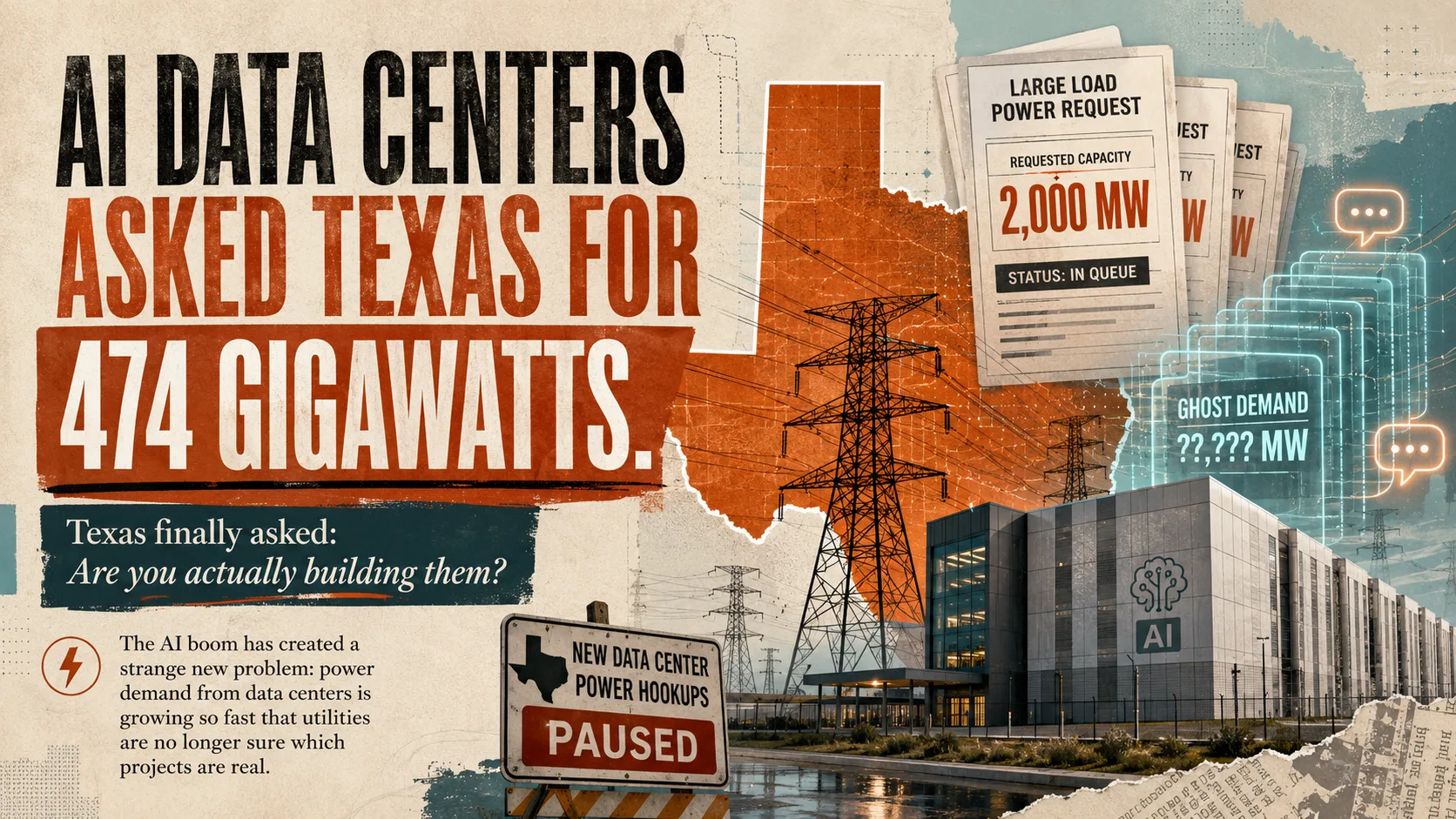
A number in a Reuters report caught my attention this week: 474 gigawatts. That is how much electricity data centers and other large users have now asked the Texas grid to supply. In 2023 the figure was about 48 gigawatts.
The easy read is that AI demand is exploding. The harder read is that a lot of those projects are guesses. Some are speculative. Some are the same project shopped to three locations at once. Some have no financing behind them.
Texas has now frozen new grid connections for data centers while regulators sort the backlog and figure out which proposals have real money and a real path to operating. Other states are asking the same thing. The industry even has a name for the problem now. It calls it ghost demand.
Why does one developer's forecast bind the whole grid?
A large data center can draw the power of a small city. The grid must build for it years before anyone knows the project is real.
A proposed data center is not another office building. These sites can draw enormous amounts of electricity, so the utility may need new power plants, high-voltage transmission lines and substations in place before the first rack is energized. That work takes years.
So when a developer says a large facility might be coming, the grid operator cannot shrug and wait. It has to start load forecasting and planning around the request. The trouble starts when many developers file requests for projects that are early, duplicated across sites or not yet funded.
Reuters found more than 700 gigawatts of large-user power requests across parts of the Midwest, Mid-Atlantic and South. That is more than ten times the industry's estimate of how much power U.S. data centers use today. At that point the grid is not planning around demand. It is planning around a sales pipeline. Anyone who has worked near a forecast knows how that ends.
What changes when companies have to prove the project is real?
The numbers move fast once a request costs something. Utilities that added upfront payments and study fees saw a large part of their data center pipeline drop away within months.
Exelon recently cut its estimate of high-probability data center demand by about 40%, to roughly 11 gigawatts, after it started requiring collateral from would-be customers. In Ohio, AEP's data center demand pipeline fell by more than half after the state required connection-study fees that can reach $100,000.
Texas is going further. Governor Greg Abbott's order calls for disclosure of who actually owns a proposed data center, whether it depends on public incentives, how much water it expects to use and whether it plans to generate any of its own power. Pennsylvania has tightened its process too. More than 100 data centers have reportedly been proposed there. Only about 20 have applied for the permits needed to move forward.
| Utility or state | Guardrail added | Effect on the data center pipeline |
|---|---|---|
| Exelon | Collateral and upfront payment requirements | High-probability demand cut about 40%, to roughly 11 GW |
| AEP Ohio | Connection-study fees up to $100,000 | Pipeline fell by more than half |
| Pennsylvania | Standard permit process | 100+ projects proposed, about 20 filed for permits |
| Texas (ERCOT) | Connection freeze plus ownership and financing disclosure | Under review; 474 GW requested |
Four tests that separate a planned project from a real one
The regulators asking for proof are really applying four checks. You can use the same list on any pipeline, not just a power grid.
Strip the utility jargon and the new rules come down to four questions:
Owner. Is there a named company behind this, with the expertise to actually run the facility? Abbott's order asks for exactly this.
Financing. Is the money committed, or is the project waiting on a raise, a tenant or a tax incentive that has not closed?
Customer. Is there a signed user for the capacity, or is the developer building on spec and hoping a hyperscaler shows up?
Permit. Has the project cleared the basic regulatory steps, or does "planned" just mean a slide in a deck? Pennsylvania's 100-to-20 gap lives in this question.
Call it the ghost demand filter. A request that fails two or more of these is not demand. It is ambition with a power number attached.
This is not a story about AI demand being fake
Ghost demand does not prove an AI bubble. Even after utilities cut the weak projects, what remains is still enough to strain grids in several regions.
Reuters is clear on this point. Remove the speculative and duplicated requests, and the leftover demand still pressures the grid across multiple parts of the country. The AI buildout may well justify a major expansion of generation and transmission. The problem is not the size of the forecast. It is the mix of real orders and wishful ones inside it.
That mix is familiar to anyone who runs a business. A sales pipeline looks huge until someone asks which deals are funded. A project portfolio looks healthy until someone asks which projects have a budget owner and a start date. A hiring plan looks aggressive until someone asks which roles have sign-off. An AI roadmap looks impressive until someone asks which use cases are actually in production. The grid is now living the same gap, except the cost of guessing wrong runs to billions of dollars and the infrastructure lasts for decades.
Build too little and the grid cannot serve the demand that does arrive. Build too much around projects that vanish and customers pay for power plants and lines nobody needed. That is why ghost demand matters. It is a forecasting problem with a concrete bill attached.
The physical bill for a digital forecast
It is easy to talk about AI as if it lives entirely inside software. It does not. Behind every model sit chips, cooling systems, land, water, transmission lines and a large amount of electricity.
Big Tech's planned spending on AI data centers is expected to pass $700 billion this year, by Reuters' accounting. At that scale a bad forecast stops being an internal budgeting question. It starts shaping which communities get a substation, which utilities take on decades of debt and what shows up on household power bills.
The useful way to read the Texas freeze is not as a brake on AI. It is a late attempt to separate real demand from ambition before someone pours concrete around the number. For most of the past few years the AI infrastructure story ran on one word: speed. More chips, more sites, more power, more capacity. Texas has now added a slower word to the conversation. Proof.
What should you check before you build on a forecast?
Run the four tests on your own pipeline this quarter. Owner, financing, customer, permit. Whatever fails two or more is not a plan you should fund yet.
If your team is sizing an AI roadmap, a hiring plan or a capital request against projected demand, the Texas story is a cheap lesson. Ask which line items have a named owner. Ask which have committed budget rather than hoped-for budget. Ask which have an internal customer who has actually asked for the output. Ask which have cleared whatever approval your organization treats as a real gate.
The requests that pass are your forecast. The rest are worth tracking, but not worth building around. Regulators took a few years and a 474-gigawatt backlog to relearn that. You can borrow the lesson for the price of an afternoon.
AI may be digital. The bill for getting its forecast wrong is very physical, and it does not land on the company that filed the request. It lands on everyone connected to the same grid.
Sources
- Reuters: "Texas' halt on powering data centers reflects US reckoning over 'ghost' demand" (Sept 1, 2026)
- BNN Bloomberg (Reuters syndication): Texas data center power freeze, 700 GW of requests and $700 billion in AI spend
- Utility Dive: "Exelon 'high probability' data center load falls 40%"
- Data Center Frontier: AEP data center capacity growth and Ohio connection-study rules
- Office of the Texas Governor: executive order on data center grid disclosure
Related Articles on Nexairi
Jim Smart is the founder and editor in chief of Nexairi. A Business Intelligence Developer with experience building data systems for Verizon, U.S. Army operations, and enterprise finance teams, Jim spent years turning complex data into decisions that executives could act on — dashboards, forecasting models, and automation pipelines across telecom and government contracting. He founded Nexairi to apply that same clarity to AI: making emerging technology understandable and actionable for the operators, accountants, and business owners who need it most. Jim holds GenAI certifications from the University of South Florida Bellini College of AI and completed Springboard's Data Science Career Track.