Does "connected" mean the same thing for every data center?
Not under a New England proposal. It describes three ways to connect a large data center, and two can be told to cut back.
On November 13, ISO New England said it had jointly filed a large-load proposal with federal regulators. The other filers were the New England Power Pool and the transmission owners' administrative committee. The ISO's information summary defines a "large load" as one customer at a single site with a gross peak demand of 50 megawatts or more, connecting at more than 60 kilovolts. The summary says some existing and critical loads are exempt. An existing site becomes a large load if its peak demand rises by 50 megawatts or more from its exempt level as of June 18, 2026.
The same summary explains why the filing exists. Federal regulators issued a show-cause order on large loads on June 18, and the ISO was given until November 16 to file its own design. So this is New England's answer to a question FERC asked.
What are the three proposed services?
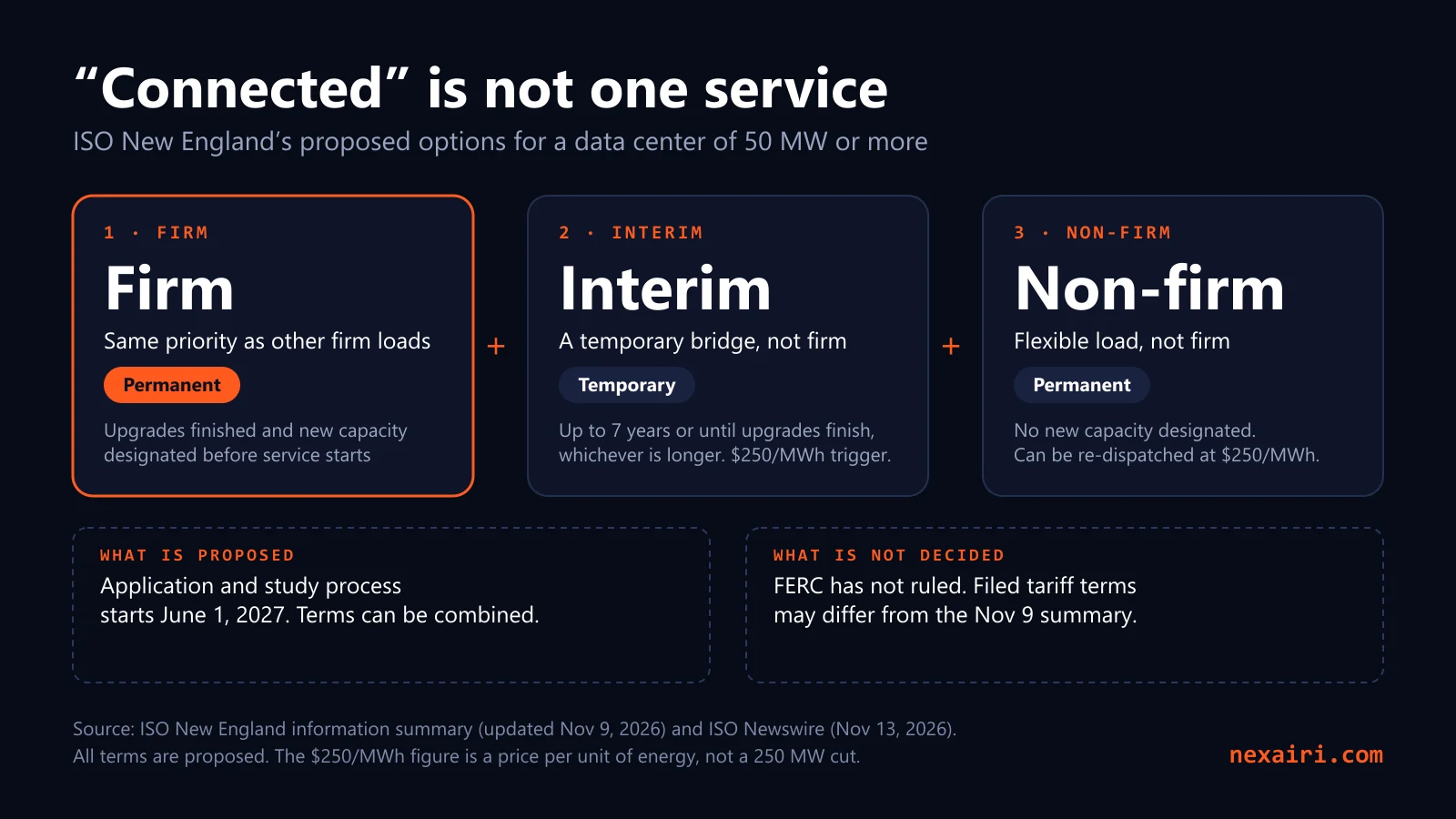
The ISO's summary names them Firm, Interim and Non-Firm Contract Demand Service. A customer can combine them to serve one site.
| Question | Firm | Interim | Non-firm |
|---|---|---|---|
| Priority | Same as other firm loads | Not firm | Not firm |
| What comes first | All network upgrades finished and new capacity designated | Offered before upgrades are done or the new-capacity rule is met | No new capacity designated. Studies reflect the load's flexibility, which may mean fewer upgrades |
| How long | Permanent, for a fixed contracted amount of megawatts | Temporary: up to 7 years or the time to finish upgrades, whichever is longer | Permanent |
| Can be told to cut back at $250/MWh | Not named in the ISO's account | Yes | Yes |
Sources: ISO information summary (updated November 9) and ISO Newswire (November 13). All terms are proposed.
The firm service is the one that carries a requirement. The summary says large loads must "bring your own new capacity," meaning new power supply matched to the new demand. The ISO also describes interim service as its own offering, not a limited mode of firm service.
Here is how the pieces could fit together. Suppose a developer wants a 100-megawatt campus. It could request firm service and wait for the upgrades and new supply that firm service requires. In the meantime it could take interim service, which the summary says is provided for the amount of firm service requested until the designated new capacity is operating. Or it could choose non-firm service and accept being told to cut back. This is an illustration of the structure, not a described customer.
What does "told to cut back" mean at $250/MWh?
The ISO says non-firm and interim customers would be re-dispatched when local prices reach $250 per megawatt-hour, meaning they cut use or add eligible generation.
Keep the units straight. A megawatt is a rate of power, like a car's speed. A megawatt-hour is an amount of energy, like miles driven. So $250/MWh is a price. It does not mean a 250-megawatt cut.
The ISO adds that the region crosses that price in only about 1% of hours. That is a regional figure. The trigger applies in the customer's own area, and the announcement we read does not define that area. How often it would bind at a given site is not shown.
The Nexairi Dispatch
See what was promised, and what shows up.
Three times a week, five minutes: the companies, money and equipment behind the AI buildout, and the evidence that it became real.
Free · Monday, Wednesday, Friday · Unsubscribe anytime
What is proposed, what is unfinished and who decides?
Proposed: the ISO says the application and study process would start on June 1, 2027. Applications would be studied one at a time in a publicly posted queue showing each request's size, location and status. The summary says studies take 90 days unless more analysis is needed, with a $50,000 non-refundable fee and a $150,000 study deposit. A later increase in a site's peak demand would require a new application.
Unfinished: stakeholder talks on the new-capacity requirement continue in 2027, per the ISO. The Nov. 9 summary also predates the filing, and the filed tariff package was not readable for this article. Final terms may differ from what is described here.
Decided by someone else: FERC. Nothing in the documents we read reports a ruling.
What the proposal shows and what it doesn't
The supported reading is narrow. A grid operator is turning "how do I connect?" into a menu where priority, timing and new-supply requirements trade against each other. Firm service asks for the most and promises the most. Non-firm asks for flexibility in return for a different path.
A fair alternative is that flexible service simply suits some customers. It is not evidence that the grid is failing. The documents do not say the proposal makes connection faster or cheaper for anyone, and they name no customer who plans to use it. Costs, uptake and the real contract terms are unknown. The people who can say what those contracts must contain are the developers who would sign them.
What would settle it?
Two things would turn this design into a fact: FERC's order on the filing and the first signed service agreement under the new rules.
Two details are worth reading once the filed tariff is public. One is how the ISO defines the area where the $250 price is measured. The other is what "certain system conditions" means in the studies for non-firm service.
Until then, "connected" can mean three different promises. The word to watch in the next headline is the one in front of it: firm, interim or non-firm.
Norway's grid operator has taken a different route and paused new data-center capacity reservations. Nexairi covered that on Substack.
Next milestone
FERC's action on the joint filing. The ISO says the application and study process would be implemented on June 1, 2027.
Sources
Related articles on Nexairi