
Why would the biggest cloud buyers fight over a small part?
An optical transceiver is a small module that sends data as light over fiber inside a data center. Amazon, Google, Meta, CoreWeave and Cisco joined Microsoft in a meeting with White House officials against a curb on Chinese ones, Reuters reported on November 17.
That is a lot of lobbying for a part most people have never heard of. It tells you the part matters. It does not tell you what has been decided.
Picture a network team holding a quote for a rack of these modules. The useful question is not the price. It is which company made each module and whether a second supplier has passed the team's tests. That question is why the fight exists.
What has the FCC adopted, and what is only reported?
The FCC has adopted a rule about components. A curb on Chinese optical transceivers is, so far, a report. The table keeps the two apart.
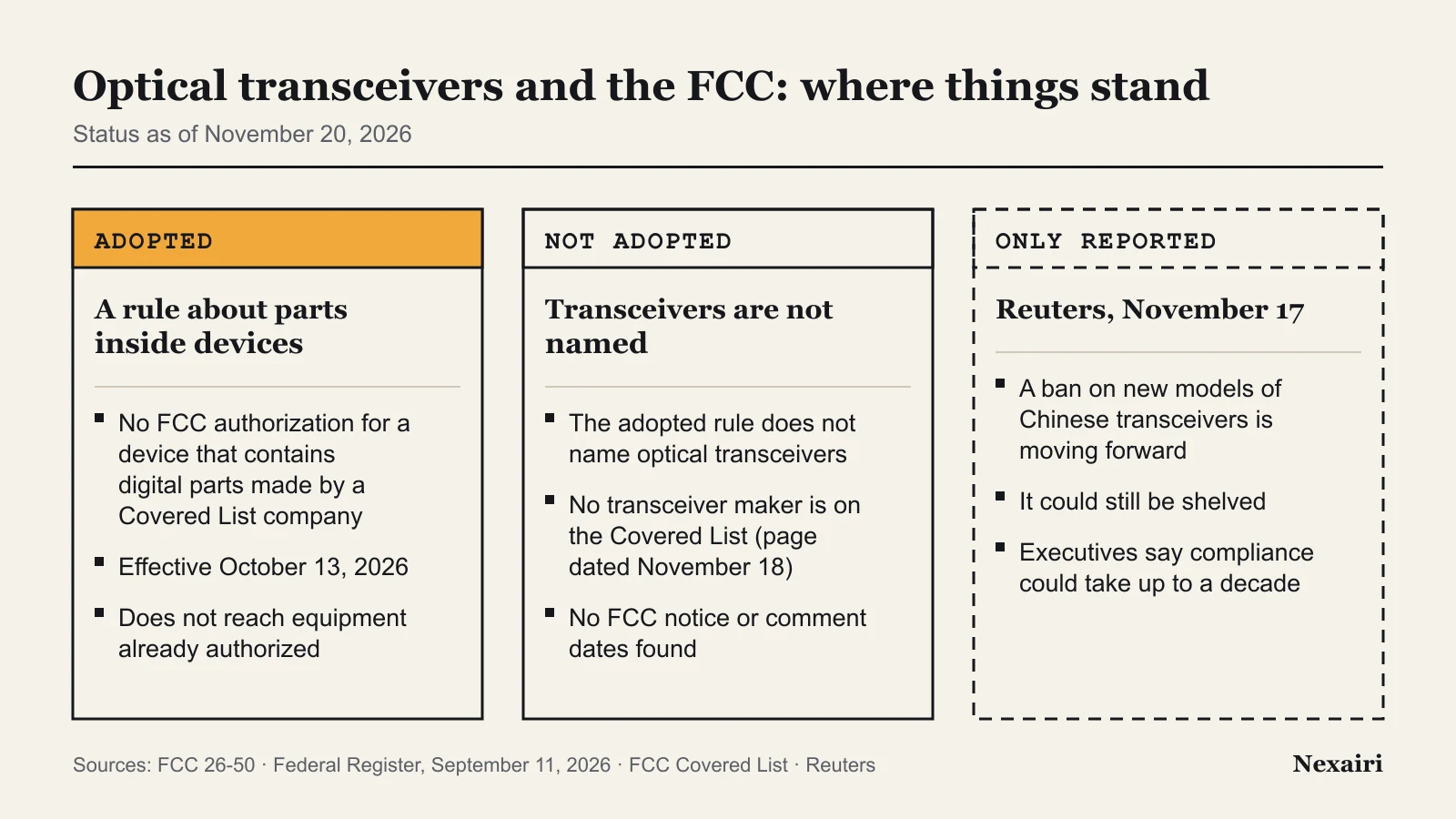
| Claim | Status | Where it comes from |
|---|---|---|
| Devices containing digital parts made by a Covered List company cannot be authorized | Adopted July 22. Effective October 13 | FCC 26-50, Federal Register |
| That rule applies to equipment already authorized | No. The order says it is prospective | FCC 26-50, paragraph 38 |
| The adopted rule names optical transceivers | No. Commenters name them (paragraph 22). The FCC asks about them in a question (paragraph 145) | FCC 26-50 |
| A transceiver maker is on the Covered List | No, as of the page updated November 18 | FCC Covered List |
| The FCC is seeking to ban imports of new Chinese transceiver models | Reported. The FCC did not respond to Reuters | Reuters, November 17 |
| U.S. firms could need up to a decade to comply | Claim by executives, per two people familiar | Reuters, November 17 |
The FCC itself said in a footnote that the optical transceiver market's key players, Coherent in the United States and Innolight in China, are not on the Covered List. It cited a market-research page it visited on May 15. The current list shows the same absence.
Reuters says the measure is advancing, according to three additional people, but could still be shelved if sentiment in the administration changes.
How could a rule about device approval reach a part inside someone else's product?
The FCC approves many devices before sale. Its July order now looks inside them, at parts made by Covered List companies.
Before the order, a Covered List company's chip inside another company's device did not by itself block that approval. The FCC calls this the component loophole and says the order closes it.
The order says devices with such parts "pose similar unacceptable risks" as the covered equipment itself. It defines the parts broadly: any module, sub-assembly or other component that uses digital techniques and generates timing pulses above 9,000 a second. It leaves questions about which components qualify to the FCC's Office of Engineering and Technology. So the order does not say whether a given transceiver counts.
The FCC has put things on the Covered List in two ways. It has named companies, such as Huawei and ZTE. Since December 2025 it has also listed whole categories made in a foreign country: drones, routers, advanced robots and power inverters. Paragraph 37 says the new component rule applies only to the first kind.
Why the route decides the reach
This is my reading of paragraph 37, not an FCC statement about transceivers. If the FCC named transceiver makers, the component rule would let it also block devices that contain their qualifying parts. If it listed every foreign-produced transceiver, as it did with routers, the modules themselves would be barred. Paragraph 37 says the component rule would not follow them into other devices.
The trade group ITI asked the FCC in an August 13 letter not to add transceivers, and above all not through an addition covering all foreign-produced units. If the FCC acted anyway, ITI urged a narrow approach aimed at producers already on the list. It also said supply disruptions could hurt data center deployment and U.S. AI leadership.
The Nexairi Dispatch
See what was promised, and what shows up.
A five-minute weekly email: the companies, money and equipment behind the AI buildout, and the evidence that it became real.
Free · Weekly · Unsubscribe anytime
Who makes the modules, and why can't a buyer switch overnight?
Fierce Network names two Chinese companies, Innolight and Eoptolink, as market leaders. ChinaTalk, an opinion piece arguing the curb is misdirected, lists Lumentum, Coherent and Applied Optoelectronics as Western makers. Marvell has agreed to merge with Lumentum. That agreement is signed, not closed.
Location matters as much as ownership. ChinaTalk reads Innolight's Hong Kong prospectus as showing about 2.8 million modules a month of overseas capacity in Thailand and Taiwan in the first quarter of 2026. A rule by producer and a rule by place would treat those modules differently.
One vendor told Fierce Network that "nobody is building" transceivers in the U.S. at volume. Vendors estimated two to three years for a rushed domestic effort and five to ten for full reshoring. Those are anonymous estimates, not filings.
Reuters adds one more dependency. A source said U.S. firms raised the chance that China would answer with limits on indium phosphide, which Reuters calls a critical mineral needed to make optical transceivers. That is a risk someone voiced, not an action China has taken.
What is the strongest alternative explanation?
The strongest alternative is that any curb stays narrow. A ban on new models only would leave installed equipment running.
The FCC order is prospective, and Reuters describes a ban on new models. Supply might barely move, and the lobbying might be industry caution about a rule not yet written.
ChinaTalk goes further and argues the security case is thin. It also notes that having no public example of harm does not prove the risk is absent. I found no FCC notice, proposal text or comment dates for transceivers in the documents above, so none of this can be tested against a draft.
What would settle it?
An FCC public notice or Covered List update naming optical transceivers or specific makers, with comment dates, would settle it.
That document would turn a report into a rule. It would also show which route the FCC chose.
Until then, the useful word is the one in front of "ban." Right now it is "reported." If you buy or finance data center capacity, ask which makers' modules are in the build.
Next milestone
An FCC public notice or Covered List update naming optical transceivers or specific makers, with comment dates. A second marker is whether China limits indium phosphide exports, which Reuters describes only as a raised risk.
Sources
- FCC 26-50, Third Report and Order (adopted July 22, 2026)
- Federal Register, final rule (September 11, 2026)
- FCC Covered List (updated November 18, 2026)
- ITI ex parte letter to the FCC (August 13, 2026)
- Reuters: Trump's China data center curb advances despite Amazon, Google, Meta lobbying (November 17, 2026)
- Fierce Network: proposed U.S. ban on Chinese optical transceivers (September 8, 2026)
- ChinaTalk: China, the FCC, and the Logic of Transceivers (October 7, 2026)
Related articles on Nexairi