Listen: the 4 min audio summary
A short spoken summary, read by our AI voice, Marie. The full story, charts and sources are on this page.
What did Applied Digital sign this week?
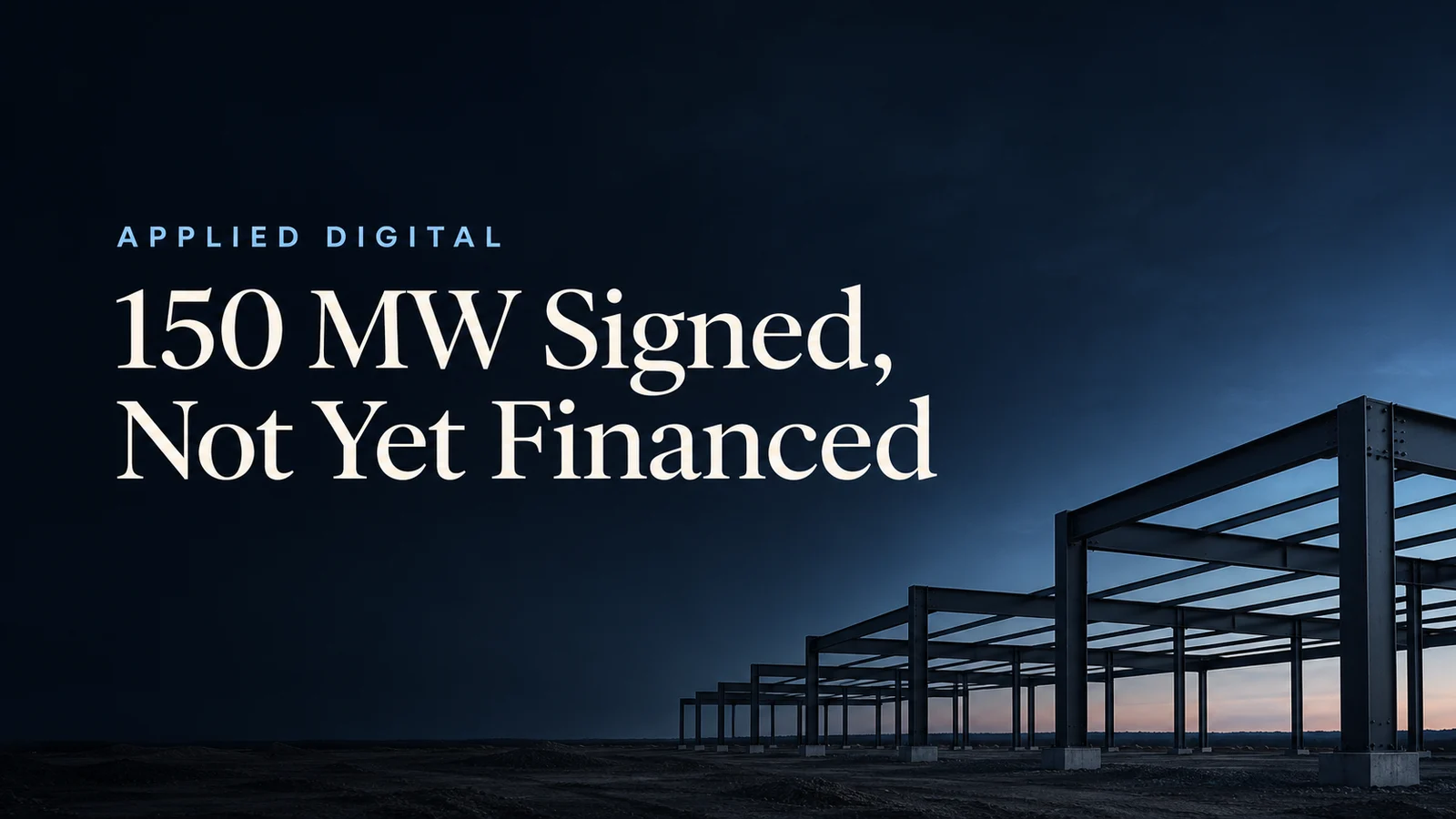
Applied Digital signed an 18-year lease for 150 megawatts with an unnamed hyperscaler, one of the very large cloud companies. The company puts the base-term value at about $5.4 billion.
Companies are promising to spend hundreds of billions of dollars building AI data centers. A promise like that has to pass four steps to become real: a customer signs, the builder finds the money, the power gets connected and the building is delivered. A megawatt is a unit of electric power. Here it measures how much electricity the customer's computers can use at once.
In a Nov. 23 release, the company called the tenant a "tier-one investment-grade hyperscaler." Investment-grade is a credit rating meaning the borrower is judged likely to repay. The release names neither the tenant nor the campus. It says all renewal options would bring the total to about $12.7 billion over 33 years.
The company also says contracted base-term lease revenue now tops $41 billion, with about 75% tied to investment-grade tenants. Those are company figures. "Contracted" means signed. It does not mean built or paid yet. For scale, $5.4 billion over 18 years is about $300 million a year, or roughly $820,000 a day (our arithmetic).
The company filed three documents together on Nov. 24: a lease release, a bridge loan release and a letter raising a stock funding line. Together they say rent is promised, cash is available under conditions and a funding line got bigger.
What does the lease work out to per megawatt?
Per megawatt, the new lease pays about 20% more each year than two earlier Applied Digital leases. That is our arithmetic from the company's own figures.
Divide each lease's base-term revenue by its megawatts and its years. The company says the new lease has "improved commercial terms over our prior leases, including higher pricing." The numbers fit that claim.
| Lease | Announced | Critical IT | Term | Base-term revenue | Per MW-year |
|---|---|---|---|---|---|
| Polaris Forge 2 | Oct. 22, 2025 | 200 MW | about 15 years | about $5.0 billion | about $1.67 million |
| Polaris Forge 3 | May 20, 2026 | 300 MW | 15 years | about $7.5 billion | about $1.67 million |
| New lease (campus not named) | Nov. 23, 2026 | 150 MW | 18 years | about $5.4 billion | about $2.0 million |
Sources: Oct. 22, 2025 release, May 20, 2026 release and the Nov. 23 release. Per-megawatt figures are ours.
Treat the comparison as rough. The inputs are rounded. The releases do not say whether rent steps up each year or what it covers. The May release calls the Polaris Forge 3 deal a "take-or-pay" lease, meaning the tenant owes rent whether or not it uses the space. The new release does not use that term, so its payment terms are not stated.
Renewals look richer still. The $7.3 billion gap between $12.7 billion and $5.4 billion, spread over the 15 added years, is about $3.2 million per megawatt-year. That holds only if the tenant uses every option, and the choice is the tenant's.
Which parts of the build are paid for?
The documents describe a financing plan, not a finished one. The plan is equity first, then project debt backed by the lease.
Chief Financial Officer Saidal Mohmand said the company plans to use "first-in equity already funded from our balance sheet," meaning owners' money that goes in before lenders', and its "$5 billion programmatic equity partnership with Macquarie Asset Management," an investment firm. Then comes "project financing supported by the long-term lease." He said it expects to complete remaining project finance for Delta Forge 1 and Polaris Forge 3 in the first calendar quarter of 2027 and for Delta Forge 2 in the second.
The gap is the new lease itself. The release does not say which campus holds it and gives no financing date for it by name. Delivery is "anticipated to begin in the first half of calendar 2028, subject to applicable development milestones, utility arrangements and regulatory approvals."
Project finance is debt secured by one project's lease and assets, not by the whole company. A lease comes first. Financing, power and delivery follow.
The Nexairi Dispatch
See what was promised, and what shows up.
A five-minute weekly email: the companies, money and equipment behind the AI buildout, and the evidence that it became real.
Free · Weekly · Unsubscribe anytime
What does the bridge loan tell us?
A bridge loan is short-term debt that covers building costs until longer financing arrives. Applied Digital closed a $300 million one for Delta Forge 1.
The second Nov. 23 release describes a delayed draw term loan with a 364-day maturity. A delayed draw loan is taken in installments as conditions are met. This one pays interest at the Secured Overnight Financing Rate, a standard short-term benchmark, plus 3 percentage points. It can be repaid at any time without a premium and the project's assets secure it. The campus is in Louisiana.
The loan's draws are conditional. They depend on "construction milestones, regulatory approvals, including state commission approval of electrical rates, lender consents and certain financial covenants." The company says it "expects to seek additional financing to fund the completion of construction at that campus."
So the money is available, but only as milestones and approvals arrive. The company is also borrowing against a campus whose lease is already signed. That is not the same as having the full construction cost covered.
What else did the same filing add?
The company's 8-K also raised a stock funding line from $2.0 billion to $2.5 billion.
The Nov. 24 filing, a form called an 8-K that public companies send the SEC to report big events, says a letter agreement with the investors raised the commitment under its Preferred Equity Purchase Agreement. That agreement covers its Series G Convertible Preferred Stock, a type of stock paid ahead of common stock that can convert into common shares. After the increase, $1,035,000,000 remains available to draw.
Subtract and you get about $1.465 billion already drawn. That subtraction is ours. The filing gives the commitment and the remaining amount, not the drawn total.
Why higher rent may not mean higher pricing
The per-megawatt gap is real arithmetic, but it has more than one reading. A longer term, built-in rent increases or a different scope of services could each push the average up. The releases do not rule any of these out. If the bridge loan matures about a year after it closed and the planned project financing slips, the bridge becomes the date to watch. That is our reading, not a statement from the company.
What would settle it?
The next checkable step is the company's project financing for Delta Forge 1 and Polaris Forge 3, planned for the first quarter of 2027.
As of the filings, the lease is signed. Financing is planned, with dates for three named campuses and none for this lease by name. Delivery is a target for the first half of 2028. If a filing shows that financing closed and the state commission approved the electrical rates the bridge depends on, the lease moves from a promise to a funded plan. If not, the 364-day clock keeps running. Three questions would sharpen the picture: which campus holds the lease, what the rent covers and when the permanent financing closes. We track the filings on the Applied Digital page on On the Record.
Sources
- Applied Digital: Form 8-K (filed November 24, 2026)
- Applied Digital: New 150 MW, 18-Year Lease with Tier-One Investment-Grade Hyperscaler, Exhibit 99.1 (November 23, 2026)
- Applied Digital: $300 Million Senior Secured Bridge Facility, Exhibit 99.2 (November 23, 2026)
- Applied Digital: Polaris Forge 3 Lease Release (May 20, 2026)
- Applied Digital: $5 Billion AI Factory Lease at Polaris Forge 2 (October 22, 2025)
Related Articles on Nexairi