What changed at Barber Lake in September?
On Sept. 25 Cipher stretched the Barber Lake lease from 10 to 20 years, moved the delivery schedule and agreed to absorb the first overruns.
Cipher's release says contracted revenue at the Colorado City, Texas site rose from $3.8 billion to over $9 billion. A binding commitment from an unnamed AI lab adds a second 10-year term, expected to bring about $5.2 billion. The amendment also sets a phased delivery. Data halls arrive from the fourth quarter of 2026 through the first quarter of 2027, and rent starts as each one is delivered. The quarterly report adds that the amendment removed the tenant's two five-year extension options.
The release blames change orders and "the continued evolution of tenant requirements." It also says Cipher "remains on track with the revised delivery schedule." Note the word "revised." On track against the new schedule is a different claim from on track against the old one.
Who pays when the site costs more than planned?
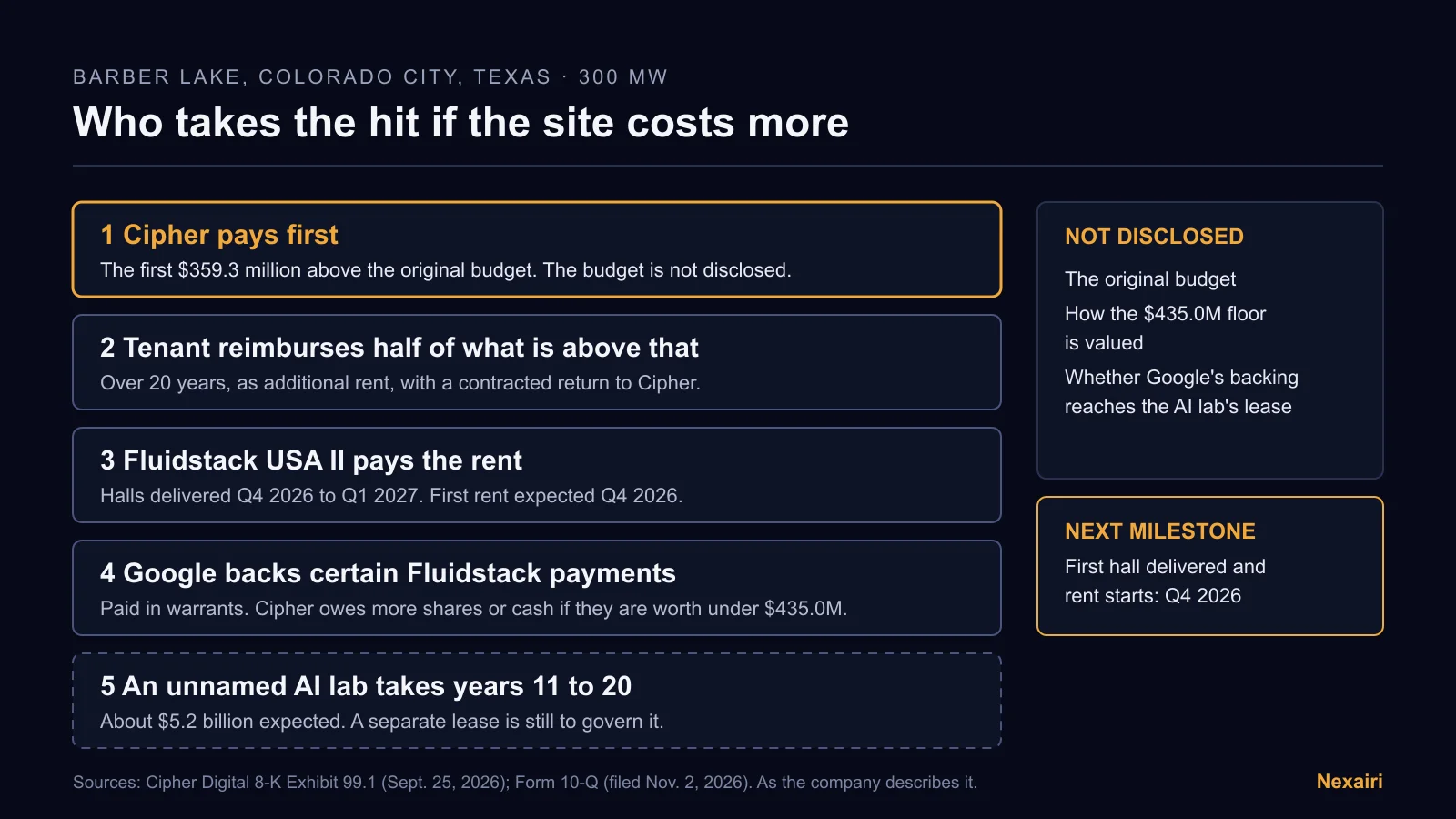
Cipher pays first. It absorbs the first $359.3 million above the original budget, and the tenant reimburses half of anything beyond that over twenty years.
The filing calls it a cost reimbursement framework among Cipher, Fluidstack and the AI lab. The tenant repays 50% of costs above the first $359.3 million, "payable as additional rent" and set to give Cipher a contracted rate of return. The 10-Q never says what the initial budget was. That matters. Without it, $359.3 million could be a thin cushion or a deep one, and a reader cannot tell which.
Two things follow from the wording, though the filing does not spell them out. Cipher fronts the cash now and gets some of it back across two decades. And Cipher keeps the other half of every dollar above the threshold.
What does Google's backstop cost Cipher?
Google agreed to back certain Fluidstack lease payments. Cipher paid for that backing with warrants and a promise about their minimum value.
Cipher issued Google a warrant for 24,178,576 shares at an exercise price of $0.01, "as consideration for Google agreeing to backstop certain obligations of Fluidstack." The company recorded a $544.5 million asset for the backstop and will spread it over the life of the lease.
The part worth reading twice is the floor. The business day before the warrant exercise period starts, the shares must be worth at least $435.0 million. If they are not, Cipher "shall be obligated to issue additional Warrant Shares and/or make a cash payment" for the shortfall. The exercise period begins on the lease's commencement date.
Divide $435.0 million by 24,178,576 shares and you get about $18 a share. Cipher added roughly 2.0 million underlying warrant shares on Oct. 16, which lowers the break-even to about $16.60. For context, Cipher's own stock sales this year averaged $23.50 a share, net, over nine months. None of that tells us the price on the test date, and the filing does not give the valuation formula.
The Nexairi Dispatch
See what was promised, and what shows up.
A five-minute weekly email: the companies, money and equipment behind the AI buildout, and the evidence that it became real.
Free · Weekly · Unsubscribe anytime
Does the $9 billion add up?
The $9 billion rests on two leases: $3.8 billion signed in 2025 and about $5.2 billion expected from an unnamed AI lab.
The sum works. $3.8 billion plus $5.2 billion is $9.0 billion. The annual rent is the interesting part. The first lease averages $380 million a year over ten years. The second term, at $5.2 billion over ten years, averages $520 million, which is 37% higher. Cipher says the second lease will carry terms "substantially consistent" with the first, so rent increases built into the lease may explain the gap. The release does not say.
Two limits apply. The AI lab's commitment is binding, but a separate lease is still to govern it. And the filings do not say whether Google's backstop reaches the lab's lease or stops at Fluidstack's.
How is Barber Lake financed?
Cipher funds Barber Lake with several layers of debt and equity, and the filings do not say which dollars go to which part.
| Layer | What the 10-Q says |
|---|---|
| Tenant rent | Fluidstack USA II leases the 300 MW site. Phased commencement expected in the fourth quarter of 2026 |
| Backstop | Google backs certain Fluidstack payments. Cipher paid in warrants with a $435.0 million value floor |
| First loss on overruns | Cipher, up to the first $359.3 million above budget |
| Senior secured notes | Cipher Compute 2030 notes, 7.125%, about $1.73 billion outstanding. "No amortization will be payable prior to the completion of the Barber Lake Facility" |
| Convertible notes | The 2031 notes' remaining proceeds are expected to finance part of Barber Lake construction. The 2032 notes, issued Oct. 16, are expected to fund "the additional equity investment at Barber Lake" |
| Revolving credit | Borrowings capped at $50.0 million until Barber Lake or Black Pearl begins operations. Nothing borrowed at Sept. 30 |
The 10-Q does not say how much of the senior notes went to Barber Lake. The only tie it states is the repayment rule: no principal is due before the site is complete.
Reading the stack
Each layer protects a different party. The Google backstop protects Cipher's rent, and the value floor protects Google. Cipher sits between them, paying first on costs and owing more shares or cash if its stock falls. That is our reading of how the pieces fit. The filings describe each piece but never draw the whole picture.
What settles it?
The next checkable event is the first data hall opening and rent starting, which Cipher expects in the fourth quarter of 2026.
That date is close. The last halls are due in the first quarter of 2027. The warrant exercise period opens when the lease commences, and the floor is tested the business day before. The filing does not say whether that is the first rent date. Cipher's filings will show whether the first delivery came on time, whether costs landed inside the $359.3 million and whether the floor was met. We follow each one on Cipher's On the Record page and on the Barber Lake card in the Project Directory.
What the filings leave unsaid
On paper this is a long contract with a Google backstop. It is also a set of promises stacked on one site.
Fluidstack pays the rent. Google stands behind part of it. Cipher pays first when costs rise and owes Google more if its stock slips. The original budget and the formula for the floor are missing, and without them the exposure cannot be measured.
Sources
Related Articles on Nexairi