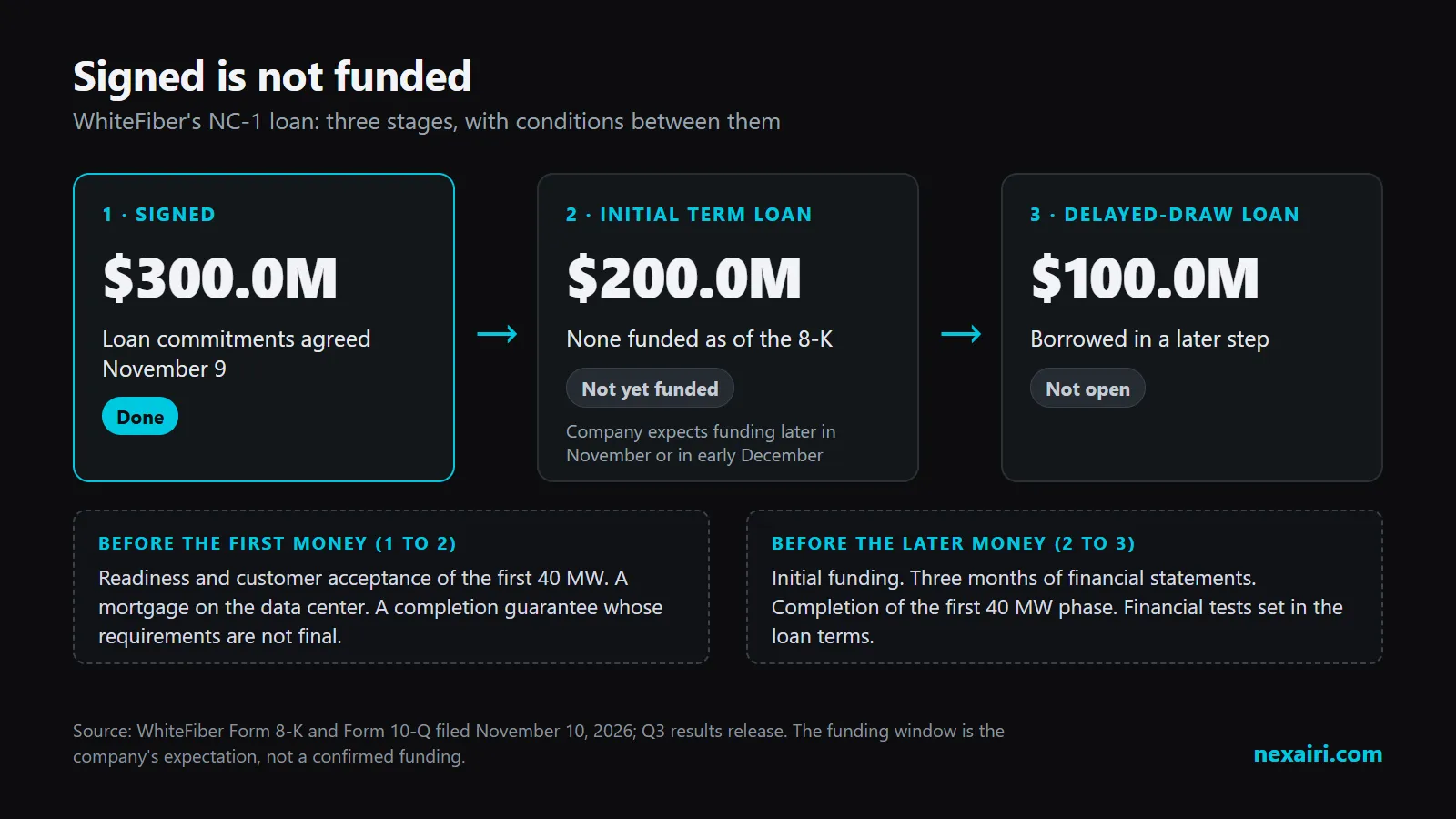
WhiteFiber's subsidiaries signed a $300 million loan agreement on November 9. WhiteFiber's own filing says that as of its date, no loans had been funded.
Both statements hold. A signed loan and money in the bank are different steps, and this loan has conditions between them. Here is the record, one date at a time.
WhiteFiber rents out data center space and AI computing power. The loan is for NC-1, its data center in Madison, North Carolina. The facts below come from its 8-K filed November 10, its 10-Q filed the same day and its third-quarter results release. Where a number is our own arithmetic, we say so.
What did WhiteFiber sign, and what still has to happen?
WhiteFiber signed a $200.0 million initial term loan and a $100.0 million delayed-draw term loan. Each has its own conditions.
A term loan has a fixed repayment schedule. A delayed-draw loan can be borrowed in later steps, once conditions are met. Morgan Stanley Senior Funding is the administrative agent for the lenders.
| Piece | Amount | What has to happen first |
|---|---|---|
| Initial term loan | $200.0 million | Readiness and customer acceptance of the first 40 megawatts at NC-1. Also a mortgage on the data center and a completion guarantee from a WhiteFiber operating partnership. The guarantor's minimum net-worth and cash tests were not yet final. |
| Delayed-draw term loan | $100.0 million | Initial funding first. Then monthly financial statements for three full calendar months after delivery. Final completion of the first 40-megawatt phase. Financial tests that the 8-K calls "pro forma" and does not spell out. The borrowing window closes six months after initial funding. |
A megawatt measures electric power. Here it means the power available to customers' computing equipment. The 8-K names the readiness and acceptance test. The 10-Q adds the mortgage, the guarantee and the open guarantor tests.
When could the first money arrive?
The 8-K schedules initial funding within 30 days of the agreement's closing date, with up to two 30-day extensions. WhiteFiber's release expects it later in November or in early December.
The filing does not give the closing date, so no calendar date follows from it. Our arithmetic: with both extensions, funding could land up to 90 days after closing. The company's own range is shorter. Its release says funding is expected "later in November or in early December" and remains subject to the customary conditions.
What financing came before this loan?
An earlier loan from Bit Digital Capital is tied to NC-1. The 10-Q calls it near-term capital while WhiteFiber seeks permanent financing.
The lender is a subsidiary of Bit Digital, and the 10-Q lists the interest as a related-party expense. A WhiteFiber subsidiary signed the loan on May 20 for up to $100 million. It drew $50 million in May and, the 10-Q says, repaid it by September 30. It drew $20 million and $10 million in late July and another $70 million on October 27.
The 10-Q says the facility supports "near-term growth initiatives in both its data centers and cloud services businesses." It says the October advance supports "liquidity requirements." So the filings do not tie these advances only to NC-1 construction.
The bridge loan has a stated price. Its contractual rate started at 9.5%. A clause called MOIC lifts the lender's total payments to at least 1.1 times the amount lent. The 10-Q puts the average effective rate at 25.7% as of September 30.
The new loan's Term SOFR option (a benchmark rate banks use) carries a 2.00% floor plus 6.00%. Our arithmetic: that is at least 8.00%, before the upfront and funding premiums the 8-K also lists. The two rates are not directly comparable.
The 8-K and the 10-Q's financing note do not say whether the new loan will repay the Bit Digital advances. The 8-K lists construction and punch-list costs, reserves and fees as uses of the money. It adds that proceeds may also fund permitted distributions to equity holders, subject to the agreement. The release says proceeds are expected to reimburse part of the development equity WhiteFiber has already invested.
The parent company is not a guarantor. The borrowers are subsidiaries, and the 10-Q says "the loans are not guaranteed by WhiteFiber, Inc." The parent reported $147.6 million of cash and restricted cash at September 30.
Nexairi Dispatch
Get the next AI move before it turns into a workflow problem.
Join the free newsletter for concise AI news, practical checklists, and the decisions practitioners need to make next.
Free. No spam. You will also get the Nexairi Dispatch.
Does "all 40 megawatts online" clear the first condition?
Not on its own. The company says all 40 megawatts are operational, yet its 10-Q says funding still depends on customer acceptance.
WhiteFiber's release quotes its chief executive: "NC-1 is now fully operational across all 40 MW of contracted IT capacity." The release adds that the company has issued the commencement notice for the remaining capacity and has begun billing for the full contracted capacity. The 10-Q says the remaining 20 megawatts became operational as of its report date.
A week earlier the count was lower. A November 3 disclosure said about 35 of the 40 megawatts were operational. It said switchgear problems, which affect the equipment that routes and protects power, had interrupted service and billing for the first 20-megawatt hall. Our arithmetic: by the company's account, the last 5 megawatts or so came online in seven days.
These are the company's statements. A commencement notice and billing are concrete steps. The 10-Q, filed the same day, still says funding "remains subject to project-readiness, customer-acceptance and other conditions." The credit agreement would say what acceptance requires. It is not public yet, and WhiteFiber says it will file it with its next annual report.
How to read a loan headline
Follow four dates: signed, conditions met, first money and later money. Today the first is done and the second is not shown.
Staged funding is ordinary in project finance. Lenders release money as a building reaches milestones, so the conditions tie the money to a finished project and not only to a signature. The parts of these documents read here show no missed payment and no failed test. The open questions are timing and what the money replaces.
What would show the money has arrived?
A WhiteFiber 8-K or release saying the initial loans funded is the next milestone. Until one appears, the record stands like this.
| Step | Status | What would show it |
|---|---|---|
| Signed | Done November 9 | 8-K filed November 10 |
| Conditions met | Not shown | A filing or release saying they are satisfied |
| Initial $200.0 million funded | None funded as of the 8-K. The company expects later in November or early December. | A WhiteFiber 8-K or release saying the loans funded |
| Delayed-draw $100.0 million | Not open | Initial funding, three months of financial statements and completion of the first 40-megawatt phase |
The loan is real, and an 8-K sets out its main terms. The money is a separate date that WhiteFiber has not reported yet. The next checkpoint is the company's own statement that the first $200.0 million has funded. That filing may also show whether any of it repaid the Bit Digital advances.
The same gap between a financing step and money in hand shows up in IREN's "fully funded" footnote and in AMD's backing of a lease for Fermi.
Sources
- WhiteFiber: Form 8-K, Items 1.01 and 2.03, Term Loan Credit Agreement (filed November 10, 2026)
- WhiteFiber: Form 10-Q for the quarter ended September 30, 2026 (filed November 10, 2026)
- WhiteFiber: Reports Third Quarter 2026 Results (PR Newswire, November 10, 2026)
- WhiteFiber: Exhibit 99.1, NC-1 Operational and Financing Update (filed November 3, 2026)
Related Articles on Nexairi
Jim Smart is the founder and editor in chief of Nexairi. A Business Intelligence Developer with experience building data systems for Verizon, U.S. Army operations, and enterprise finance teams, Jim spent years turning complex data into decisions that executives could act on — dashboards, forecasting models, and automation pipelines across telecom and government contracting. He founded Nexairi to apply that same clarity to AI: making emerging technology understandable and actionable for the operators, accountants, and business owners who need it most. Jim holds GenAI certifications from the University of South Florida Bellini College of AI and completed Springboard's Data Science Career Track.