A supply deal can be signed in November for a factory line that does not run until 2028. Nvidia's latest supplier announcement is full of those gaps. Most headlines squash them into one word: expansion.
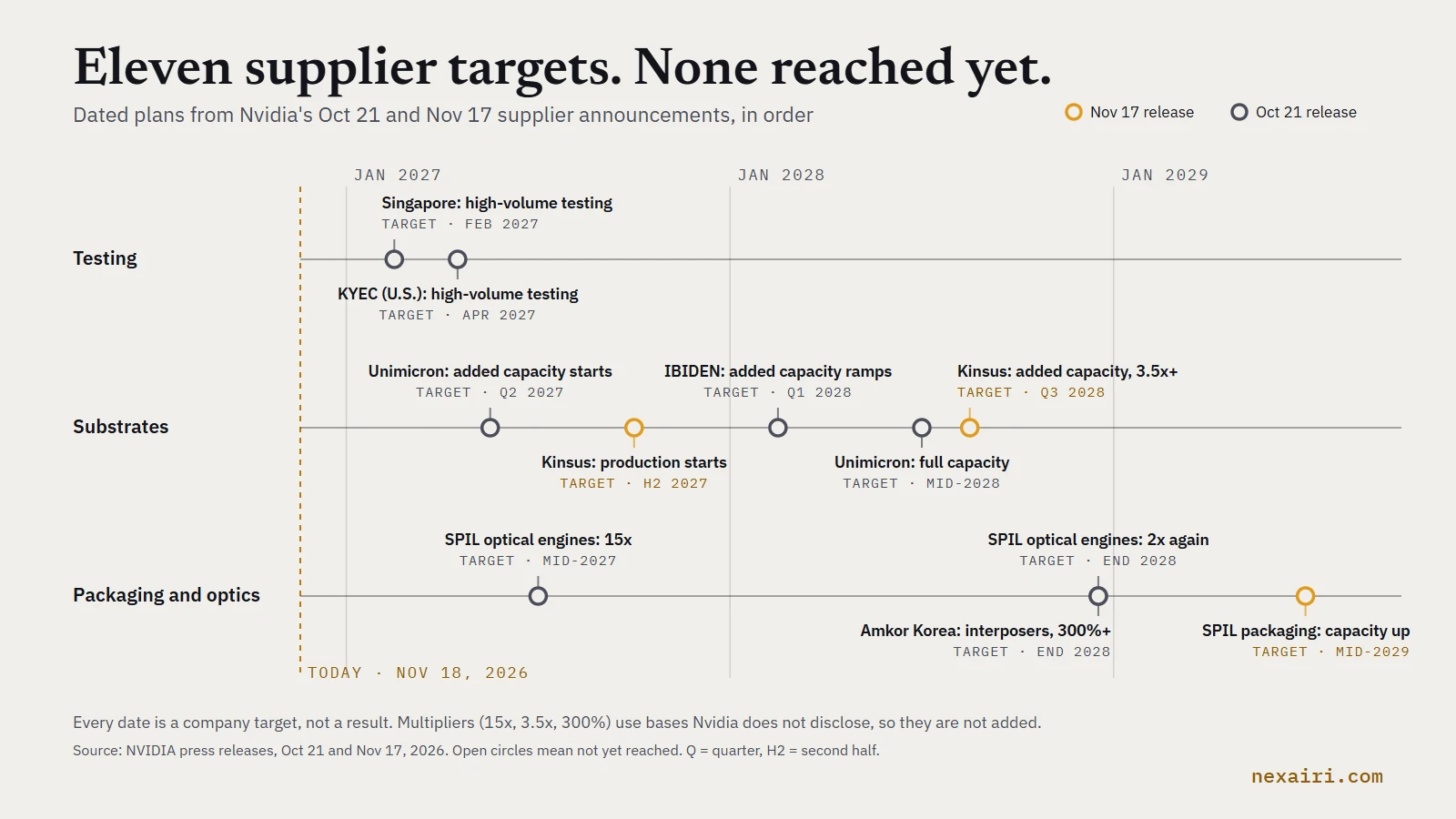
On November 17, Nvidia named six partners. Four weeks earlier, on October 21, it named a different set. Read together, the two releases hold eleven dated targets. This article puts them on one calendar.
Why does a signed supplier deal not mean new chips?
A signed deal reserves a place in a supplier's plans. New chips need the factory line to exist, pass testing and run at volume.
Those are three different dates. A deal is signed. The line starts producing. Then the added capacity arrives, which is the point where Nvidia can ship more. A headline usually reports the first date and lets the reader assume the third.
Nvidia's chief executive put the problem plainly in October: "Demand is extraordinary. Capacity is the constraint." That is why the dates matter. Each one marks a possible easing of the AI chip supply shortage, or a delay in it.
Who are Nvidia's suppliers in these two releases?
This is not a full Nvidia suppliers list. It covers the partners Nvidia named in these two announcements, and each makes a different part.
Substrates are the base boards that sit under a chip package. Kinsus, Samsung Electro-Mechanics, IBIDEN and Unimicron make them. Advanced packaging joins the processor to its memory. Amkor and SPIL do that work, and TSMC does it with CoWoS. King Yuan Electronics (KYEC) tests finished chips. Foxconn builds the servers.
A shortage in any one of these steps holds up the rest. A processor with no substrate cannot ship.
What did Kinsus and SPIL promise?
Kinsus and SPIL are the two new names on the November list. Each got its own date.
Kinsus. Under a new multiyear agreement, Kinsus plans to expand its ABF package substrate capacity dedicated to Nvidia to more than 3.5 times current levels. ABF is the film layer used to build the fine wiring inside a substrate. The work is at Kinsus's Youth campus in Taoyuan, Taiwan. Production is expected to begin in the second half of 2027. The added capacity is targeted for the third quarter of 2028.
SPIL. SPIL's work is advanced chip packaging in Taiwan, under a multiyear agreement supported by "multibillion-dollar" funding from Nvidia. Contracted capacity dedicated to Nvidia is set to increase by mid-2029. The project adds new lines for bumping, interposer wafer fabrication, assembly and testing. An interposer is the thin slab of silicon that links a processor to its memory. Our explainer on interposers and the GlobalFoundries deal covers why that step is scarce.
SPIL also appears in October for a different product. That release targets a 15x increase in its optical-engine capacity by mid-2027 and another doubling by the end of 2028. Optical engines are the light-based parts used in co-packaged optics. This is not SPIL packaging in the November sense, so the two should not be combined.
The Nexairi Dispatch
See what was promised, and what shows up.
Three times a week, five minutes: the companies, money and equipment behind the AI buildout, and the evidence that it became real.
Free · Monday, Wednesday, Friday · Unsubscribe anytime
What does the full calendar look like?
The table below lists every dated target in both releases, in order. Each row is a plan from Nvidia's own announcements.
| Target date | Supplier | What is targeted | Release |
|---|---|---|---|
| February 2027 | Singapore testing sites | High-volume testing production begins | Oct 21 |
| April 2027 | KYEC (U.S.) | High-volume testing production at new U.S. facilities | Oct 21 |
| Q2 2027 | Unimicron | Substrate capacity additions begin | Oct 21 |
| Mid-2027 | SPIL | Optical-engine capacity up 15x | Oct 21 |
| Second half of 2027 | Kinsus | Substrate production begins | Nov 17 |
| Q1 2028 | IBIDEN | Additional substrate capacity ramps | Oct 21 |
| Mid-2028 | Unimicron | Substrate capacity reaches full level | Oct 21 |
| Q3 2028 | Kinsus | Additional substrate capacity (more than 3.5x current) | Nov 17 |
| End of 2028 | SPIL | Optical-engine capacity doubles again | Oct 21 |
| End of 2028 | Amkor (South Korea) | Interposer wafer capacity up more than 300% | Oct 21 |
| Mid-2029 | SPIL | Contracted advanced packaging capacity increases | Nov 17 |
Two things stand out. The first checkable dates are in testing, not substrates. The newest release also pushes the calendar out. The October dates end in 2028, and SPIL's November target lands about six months after that. From today, mid-2029 is roughly two and a half years away.
How to read the calendar
Long gaps are not proof of delay. Substrate lines and packaging lines take years to build, fill with equipment and qualify. A date in 2029 can simply be an honest date.
The risk is in reading the multipliers. Kinsus says 3.5x and IBIDEN says 3x at its Ono plant, but each is measured against a base Nvidia does not give. Adding them together would produce a number that means nothing. Nvidia's own total, 2.5x for substrates over three years, covers the October deals only.
What does Nvidia leave out?
Nvidia leaves out quite a lot, including starting capacity, money actually paid and test results. Those gaps are where the next questions sit.
- Starting capacity. No release gives current output for Kinsus, SPIL or IBIDEN, so no multiplier converts to a unit count.
- Money paid. Some amounts are stated. Amkor's agreements total nearly $3 billion with prepayments, and KYEC's capacity reservation advance is $1.1 billion. SPIL's and IBIDEN's funding is described only as multibillion-dollar. An announced amount is not the same as money delivered.
- Qualification and yield. A new line has to pass customer testing before it ships. Neither release says when or whether that happens.
- Remedies. Neither says what happens if a supplier misses a date.
Every figure above comes from Nvidia. As of November 18, Nexairi found no independent confirmation of the Kinsus numbers.
What would count as delivery?
For each row, the proof would come from the supplier, not from Nvidia. That means reported equipment installed, production approved by the customer and shipments that follow.
The earliest test is February 2027, when Singapore testing is meant to reach high volume. Kinsus's production start in the second half of 2027 is the first substrate checkpoint. If a quarterly report from any of these companies mentions its line, compare the wording to the row in the table. Watch the verbs. "Planned," "targeted" and "expected" are not the same as "completed."
A signed deal tells you what a company intends. The calendar tells you when to look again. The next time a supplier headline says expansion, ask which of the three dates it is about.
Sources
Related Articles on Nexairi