Why did Nvidia buy Hugging Face?
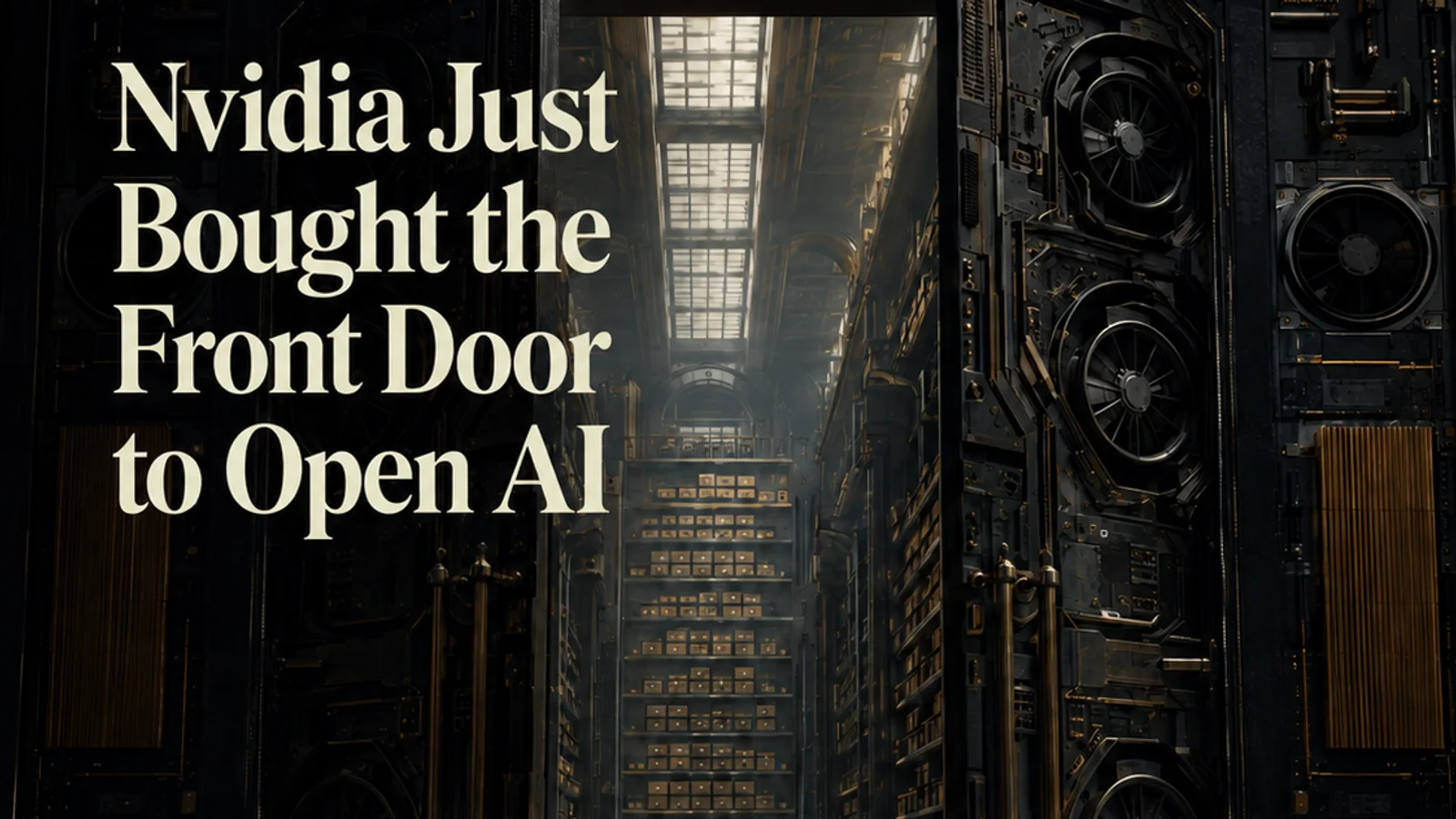
The promise of open AI was choice. Hugging Face is where that promise worked in practice. Now the company that sits under most of the AI economy owns it.
For years, the appeal of open AI has been that a company would not have to depend on OpenAI, Anthropic, Google or another closed provider. Developers could download models, change them, run them on their own machines and pick the hardware and software that fit.
Hugging Face is one of the places that vision actually worked. On September 3, Nvidia said it has agreed to buy it for $12.93 billion, roughly $11.9 billion to Hugging Face investors and a retention pool of up to $1 billion for employees who move to Nvidia. Nvidia says the platform stays open, developers keep their choice of frameworks and clouds, and Nvidia chips will not be required.
That commitment matters. So does the ownership. Nvidia is not another AI company buying an interesting startup. It already sits underneath a large share of the AI economy, and now it is moving up the stack.
What is Hugging Face, and why does owning it matter?
Hugging Face is the "GitHub of AI," the place developers go to find and test models. Owning that is different from owning any single model.
The shorthand people use is "the GitHub of AI." It fits, and it explains why this deal is bigger than buying a model company. Hugging Face hosts more than 3 million models, 500,000 datasets and 1 million applications, per figures released with the deal. More than 18 million people use it and more than 200,000 companies take part in its ecosystem.
Developers go there to discover models. Researchers publish there. Companies evaluate technology there. Open-source projects build their communities there. Hugging Face does not have to own the model that wins. It owns a large part of the place where models get found, judged and adopted. That is a different kind of power, and it is harder to compete away.
Why doesn't Nvidia need every model to run on Nvidia?
Forcing developers onto Nvidia chips could damage the platform it just bought. Owning the ecosystem and staying the easiest path through it is the subtler move.
Nvidia's position in AI has been simple to describe. Build powerful chips. Sell enormous amounts of compute. Write software that makes those chips easier to use. Then benefit as the industry needs more processing power.
The ground is shifting. Several of Nvidia's largest customers are building their own AI chips to lean less on Nvidia. That custom silicon is part of the backdrop to this deal. Buying Hugging Face gives Nvidia a different kind of leverage. It does not need to push developers onto Nvidia hardware. Doing that could break the thing it is paying for. It can own the ecosystem while keeping its own hardware and software the smoothest route through it.
The winning platform does not always need to lock the door. Sometimes it just needs to own the hallway.
| Layer | What it is | Why owning it is leverage |
|---|---|---|
| AI application | End-user apps and domain tools | Closest to revenue, but easiest for a rival to displace |
| Model and data discovery | Where developers find, test and pull models (Hugging Face) | Shapes what gets adopted without owning any model |
| Framework and inference software | Tools and runtimes to train and run models | Sets the default runtime and the path of least resistance |
| Compute | GPUs, cloud capacity and custom silicon | Nvidia's historical stronghold, now under pressure |
Does open source mean neutral?
Open and neutral are not the same. A platform can support competitors while steering engineering, promotion and defaults toward its owner's products.
There is no reason today to assume the openness promise is false. But a platform can back rival tools and still build incentives around its owner. It decides which integrations get the most engineering time. Which tools get featured. Which benchmarks are easiest to run. Which enterprise features get funded. Which deployment path becomes the default.
None of that requires closing the platform. They are ordinary product choices. The question is whether those choices start to matter more when one of the most powerful AI infrastructure companies in the world owns the platform making them.
Is this becoming a pattern in AI?
The valuable positions are moving from the model itself to the layers between the model and the customer. Nvidia is buying one of those layers.
The early AI debate was about models. Whose is smartest? Whose has the biggest context window? Who wins the benchmark? Those questions still matter, but the industry is maturing into something wider. The valuable spots increasingly sit between the model and the customer: the chips, the cloud, the developer tools, the data, the orchestration layer, the marketplaces, the model repository itself.
Earlier technology eras rhymed with this. Owning an operating system could be worth more than owning any single application. Owning an app store could be more powerful than building every app. Owning cloud infrastructure could create influence across thousands of software companies without competing with each one directly. Hugging Face looks more and more like that kind of layer for AI. Nvidia clearly thinks it is worth nearly $13 billion.
Incentives have a habit of becoming architecture
The practical question is not whether Hugging Face stays open. It probably will, at least as the stated plan. Huang said the platform will keep supporting open-source and open-weight models while letting developers choose their own infrastructure.
The more useful question is what happens to the AI market when the companies supplying the infrastructure also own the ecosystems sitting above it. Ownership does not make a technology bad. It changes incentives, and over time incentives tend to harden into architecture: the default integration, the tuned benchmark, the deployment path everyone takes because it is the one that just works.
The original pitch for open AI was that developers would have more choices. Nvidia says those choices are staying. We now get to see what choice looks like when one of the most powerful companies in AI owns the place where much of it happens.
What should you add to your vendor checklist?
Add one line: who owns the layer I depend on, and who owns the layer beneath that? Ownership does not make tech worse, but it changes the incentives.
If your team picks AI technology, the Nvidia deal points to a new question for vendor reviews. For each layer you rely on, the model, the framework, the repository, the cloud, the chips, write down who owns it and who owns the layer under it. Where the same company owns two or three layers in a column, expect its products to become the smoothest path over time.
That is not a reason to avoid Hugging Face or Nvidia. It is a reason to know where your defaults come from, so you notice when a "recommended" option is also the owner's option. The choices are still there. They just have an interested party arranging them now.
Sources
- Nvidia: NVIDIA to Acquire Hugging Face (Sept 3, 2026), with the Jensen Huang openness statement and platform figures
- TechCrunch: Nvidia confirms it will buy Hugging Face for $12.9 billion
- CNBC: Nvidia agrees to buy Hugging Face for almost $13 billion in AI expansion
- NBC News: Nvidia to buy Hugging Face in a bet on open AI models
Related Articles on Nexairi
Jim Smart is the founder and editor in chief of Nexairi. A Business Intelligence Developer with experience building data systems for Verizon, U.S. Army operations, and enterprise finance teams, Jim spent years turning complex data into decisions that executives could act on — dashboards, forecasting models, and automation pipelines across telecom and government contracting. He founded Nexairi to apply that same clarity to AI: making emerging technology understandable and actionable for the operators, accountants, and business owners who need it most. Jim holds GenAI certifications from the University of South Florida Bellini College of AI and completed Springboard's Data Science Career Track.