It's 8:15 on Sunday night. You're on the couch, half-watching something, but your thumb keeps refreshing email. You open the app. 47 unread messages. Three look like client fires. Two are "quick questions" that never are.
Your heart rate climbs. You start drafting replies in your head. By bedtime, you're not rested. You're pre-exhausted for a Monday that hasn't started.
Most productivity gurus tell you to "just don't check your email." For a practitioner—an accountant, a lawyer or a manager—that's unrealistic advice. The dread doesn't come from the email. It comes from not knowing what's inside it.
The goal isn't "Inbox Zero." It's "Mental Zero." You can get there in 15 minutes by turning ChatGPT into your Sunday night executive assistant.
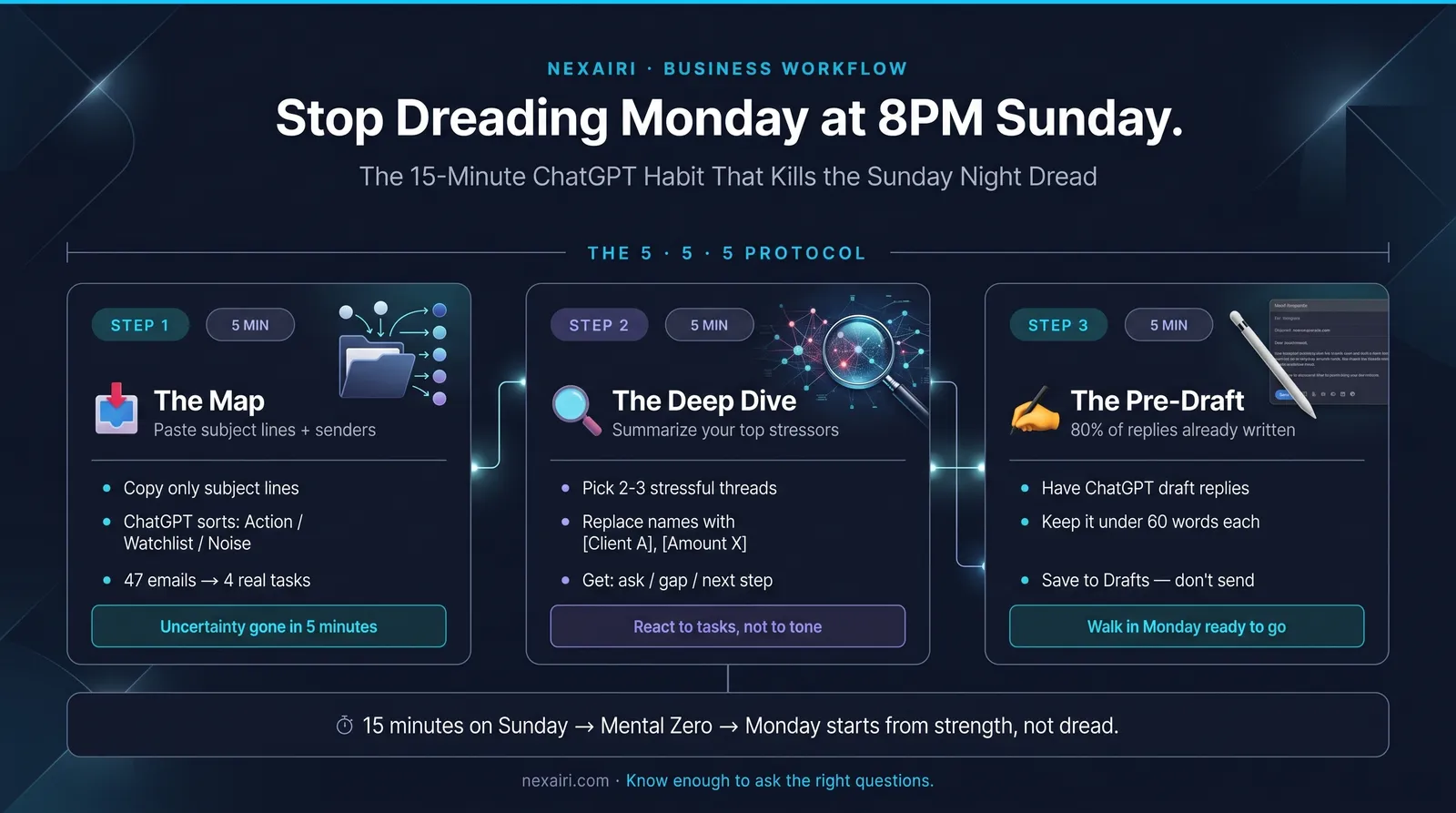
The 5-5-5 Triage Protocol
This isn't about answering every email. It's about mapping the terrain so you can stop worrying about it. Set a timer for 15 minutes and follow this three-step protocol.
1. The "Map" (5 Minutes)
Open your inbox. Copy only the subject lines and senders of your unread messages. Don't read the bodies yet. Paste them into ChatGPT with this prompt:
"I'm an [Accountant/Manager]. I'm doing a Sunday night triage. Here is a list of senders and subject lines. Categorize them into: Immediate Action (needs reply Monday morning), Watchlist (Important but can wait) and Noise (FYIs/Newsletters). Format as a table with a one-sentence guess on the priority level."
Suddenly, those 47 unread messages become a table of 4 "Immediate" items and 43 things you can safely ignore until Tuesday. The uncertainty is gone.
2. The "Deep Dive" (5 Minutes)
Find your 2-3 most stressful threads. Copy those emails, replace any client names with placeholders, and paste into ChatGPT:
"Summarize this thread into three bullets: 1) What they are actually asking for, 2) The missing information I need from them, and 3) A suggested first step for Monday morning."
You're no longer reacting to their tone or urgency. You're extracting what the task actually is.
3. The "Pre-Draft" (5 Minutes)
For those threads, have ChatGPT draft a "First Pass" reply.
"Write a direct, professional reply to this. Acknowledge I received it, tell them I am reviewing the data Monday morning, and ask for [Missing Piece of Info]. Keep it under 60 words."
Copy these into your Drafts folder. Don't hit send. The goal: walk in Monday morning with your replies already 80% written.
The Privacy Guardrail
Your biggest AI risk as a professional is leaking client data. Never paste a Social Security Number, bank balance or tax ID into a public AI model.
Use placeholders. If a client named "John Smith" is asking about a "$45,200 tax liability," change it to "[Client A]" and "[Amount X]" before pasting. ChatGPT doesn't need the real numbers to help you draft the reply.
Why it kills the Sunday dread
Your brain won't stop chewing on anything it hasn't solved. Psychologists call these unresolved items Open Loops — a concept known as the Zeigarnik Effect. The Sunday dread is nothing but a pile of them.
Triage closes those loops. You have a map. You have a summary. Your first three moves are already on the board. You're not working on Sunday. You're removing the friction of Monday.
Want to reclaim more of your time?
Every week, we send one specific workflow that removes friction from your week. No hype.
Join 12,000+ Professionals on The DispatchSources
- OpenAI ChatGPT — AI assistant for professional drafting and organization
- Zeigarnik, B. (1927). "On finished and unfinished tasks," Psychologische Forschung — foundational research on cognitive loops and task completion effects
- Psychology Today: The Zeigarnik Effect — Contemporary overview of why unresolved tasks create mental tension
Free Assessment
Is your firm ready for AI?
A 5-minute governance check for CPA firms using ChatGPT, Copilot or AI accounting software. Get your score and your top gaps — free.
Sydney Smart is a Certified Public Accountant, Fractional CFO, and Controller with over 17 years of experience across public accounting and corporate finance. She holds a Master's degree in Taxation from Georgia State University, is a licensed CPA through the Georgia Society of CPAs, and is a certified QuickBooks Pro Advisor. Sydney spent 13 years as a Senior Tax Manager at Hungeling CPA preparing and reviewing hundreds of tax returns annually for corporate, partnership, and individual clients before moving into corporate controller roles. As Founder of Simply Smart Consulting, she partners with founders and growth-focused businesses to build financial systems that scale — budgeting, cash flow forecasting, GAAP compliance, and real-time KPI reporting. She reviews Nexairi's accounting and finance coverage to ensure accuracy for the CPAs, CFOs, and operators who rely on it.