What Did Nvidia Actually Get When It "Didn't Buy" Groq?
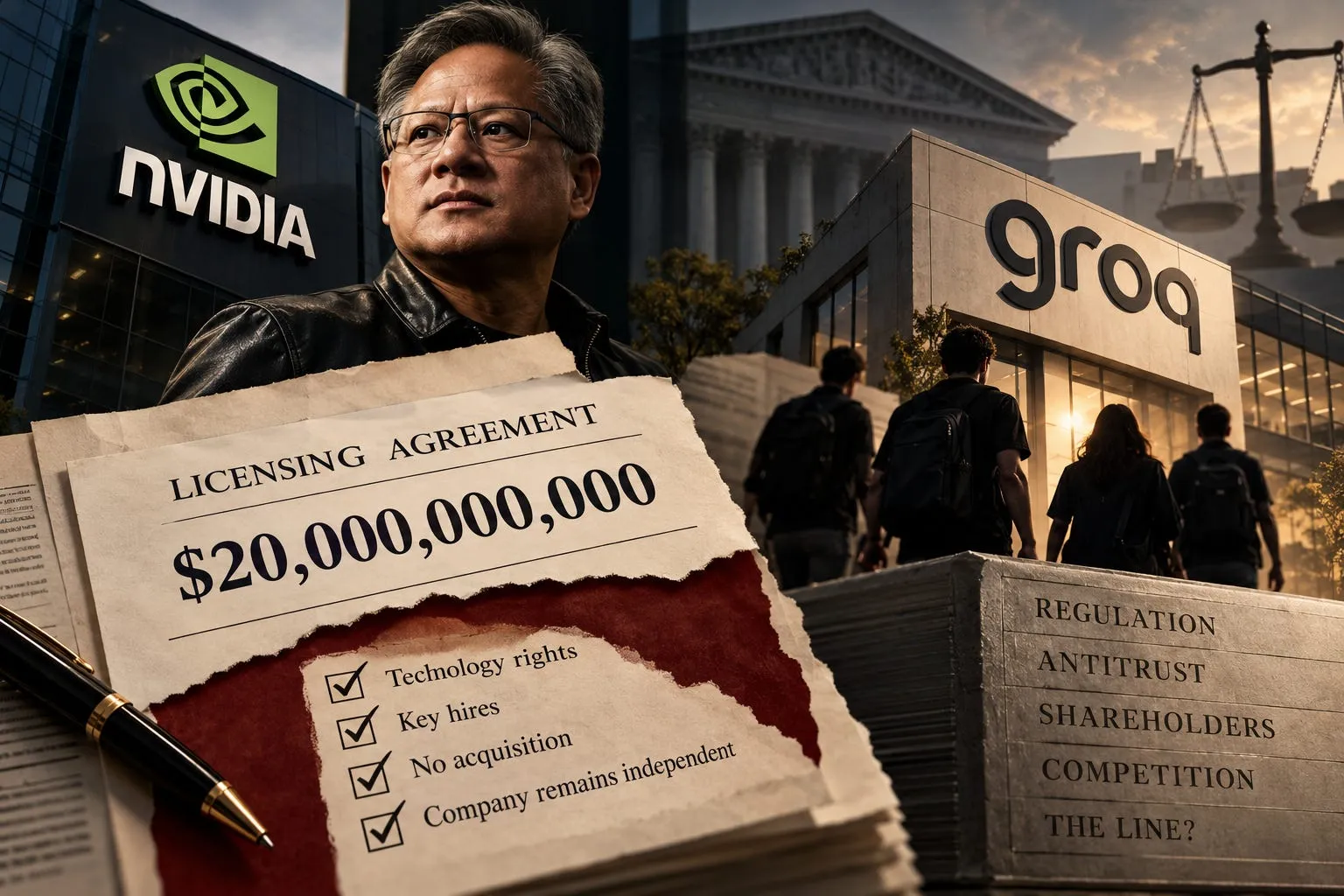
Nvidia paid Groq about $20 billion and walked away with the founder, the president and most of the engineering team, without buying the company.
The deal closed in December 2025. Nvidia paid roughly $17 billion in cash to license Groq's inference technology, the chip design behind Groq's fast, low-cost way of running trained AI models. It set aside another $3 billion in Nvidia stock for about 200 Groq engineers who joined the company, close to 90% of Groq's workforce. Founder Jonathan Ross and president Sunny Madra went with them. Nvidia later rolled Groq's technology into its next-generation LPX inference platform, announced at its GTC conference.
Groq itself kept existing. It kept its name, its cloud business and, technically, its independence. In June 2026, it raised another $650 million to expand that cloud business toward 200 megawatts of capacity by the end of 2027, and today runs 13 data centers serving more than 5 million developers.
On paper, two separate companies. In practice, one company sent the other its most valuable people and technology, and kept operating.
Why Are Former Groq Engineers Suing Over the Deal?
Two former Groq engineers who held stock, Joshua Rubin and Benjamin Serebrin, sued Groq's board on October 2-4, 2026, claiming it sold the company without a required shareholder vote.
They filed in the Delaware Court of Chancery. Their claim: Groq's board breached its fiduciary duty to stockholders, selling the company to Nvidia without the vote Delaware law requires and without any process to test or maximize what Nvidia was paying for. The suit alleges common stockholders came out worse than senior executives and certain investors, who got better terms out of the same deal. A Groq spokesperson told CNBC the licensing agreement "delivered exceptional value for Groq, our investors, and our employees," and called the lawsuit "meritless," promising to "vigorously defend" the company against it.
What Delaware law says about a stockholder vote
Delaware corporate law generally requires a stockholder vote before a company sells substantially all of its assets. A licensing deal, even a $20 billion one, doesn't automatically trigger that rule the way a formal merger does. That's the exact gap the plaintiffs are asking a judge to look at: if the economic result matches a sale, does it matter that the paperwork says license?
Is This Legal? What Regulators Are Actually Investigating
The Justice Department opened its own look at the deal shortly after Nvidia and Groq announced it, well before the lawsuit existed.
The DOJ's information request
Before a traditional merger can close, federal law forces the companies involved to notify regulators and wait. That law is the Hart-Scott-Rodino Antitrust Improvements Act, and it has a gap: it doesn't cover a technology license. It doesn't cover a hiring spree either. The DOJ opened its inquiry shortly after the Nvidia-Groq deal was announced in December 2025 and has since sent Nvidia a formal demand for information, according to reporting from The New York Times and Reuters. That gap in the law is exactly what investigators are looking at.
Why two U.S. Senators got involved
Senators Elizabeth Warren and Richard Blumenthal questioned Nvidia about the deal in March 2026, asking directly whether its structure was intended to avoid antitrust scrutiny. Legal expert David Pearl summed up the question both the senators and the DOJ are circling: "The issue it raises is whether this is in some sense an acquisition in sheep's clothing."
Free CPA AI Policy Checklist
Before staff paste client data into AI, check the rules your firm is missing.
Get the free checklist and join the Dispatch for practical AI controls, vendor questions, and client-data safeguards for accounting teams.
Free. No spam. You will also get the Nexairi Dispatch.
Not the First: How Other AI Giants Are Buying Without Buying
Nvidia-Groq isn't an isolated case. Large AI companies have used at least three different structures recently to gain capability without a traditional acquisition.
| Deal | Structure | Reported Value |
|---|---|---|
| Nvidia – Groq | Technology license + talent hire; target stays independent | ~$20 billion ($17B license + $3B stock) |
| Google – Windsurf | Technology license + talent hire | ~$2.4 billion |
| Meta – Scale AI | Minority equity stake, not a license or buyout | $14.3 billion for 49% |
Each one gets a large company most of what a traditional acquisition would deliver. The technology. The people who built it. Or, in Meta's case, a controlling financial stake without the word "acquisition" anywhere in the paperwork. Nvidia's version is the most aggressive of the three. It moved both the technology and nearly the entire team.
What Happens to You When Your Startup Gets Acquihired?
You may hold equity for years expecting a clean sale, then watch a bigger company license the technology and hire the team instead, without a traditional payout framework applying.
Say you joined a startup partly for the equity. You took a lower salary, stayed through a rough year or two, because you believed the company might eventually sell or go public and your shares would be worth something. Then a much bigger company shows up. It licenses the technology. It hires the people it wants, on attractive terms. The startup keeps existing, legally, but much of what made it valuable has already moved somewhere else. That's a different outcome than the clean story most people picture when they hear "startup sold for $20 billion." In a traditional acquisition, there's a familiar framework for how the money gets split. In a licensing-and-hiring deal, that framework doesn't automatically apply, and the Groq plaintiffs are arguing that's exactly where they lost out.
Reading the Gap Between the Paperwork and the Outcome
Nobody has established that Nvidia or Groq's board did anything illegal. The DOJ's request for information is a standard early step, not a finding, and the Delaware lawsuit's allegations haven't been tested in court. What the case does show, clearly, is that the three-question test is becoming a live legal standard rather than just a way of thinking about these deals: did the core technology move, did the leadership move, did most of the team move. Groq checks all three. Whether a court or the DOJ treats that as equivalent to a sale is the actual question this case will answer.
What Should You Check Next?
If you hold startup equity, read your agreement's definition of "change of control" now, before any deal happens. Know what actually triggers it.
Find out whether that clause is triggered by a change in who owns the company, or only by a formal sale of the company itself. Those are not the same question, and this case is the reason the difference now matters.
Sources
- CNBC: Nvidia's $20 billion Groq deal faces lawsuit alleging startup's stockholders were shortchanged
- CryptoBriefing: Groq engineer-shareholders sue board over $20 billion Nvidia deal
- TechTarget: DOJ reportedly probes Nvidia-Groq deal for antitrust concerns
- CNBC: Google hires Windsurf CEO Varun Mohan, others in $2.4 billion AI talent deal
- Groq Newsroom: Groq Raises $650M to Scale Its AI Inference Cloud Business
Related Articles on Nexairi
Free Assessment
Is your firm ready for AI?
A 5-minute governance check for CPA firms using ChatGPT, Copilot or AI accounting software. Get your score and your top gaps — free.
Jim Smart is the founder and editor in chief of Nexairi. A Business Intelligence Developer with experience building data systems for Verizon, U.S. Army operations, and enterprise finance teams, Jim spent years turning complex data into decisions that executives could act on — dashboards, forecasting models, and automation pipelines across telecom and government contracting. He founded Nexairi to apply that same clarity to AI: making emerging technology understandable and actionable for the operators, accountants, and business owners who need it most. Jim holds GenAI certifications from the University of South Florida Bellini College of AI and completed Springboard's Data Science Career Track.