What does the $518 billion figure actually cover?
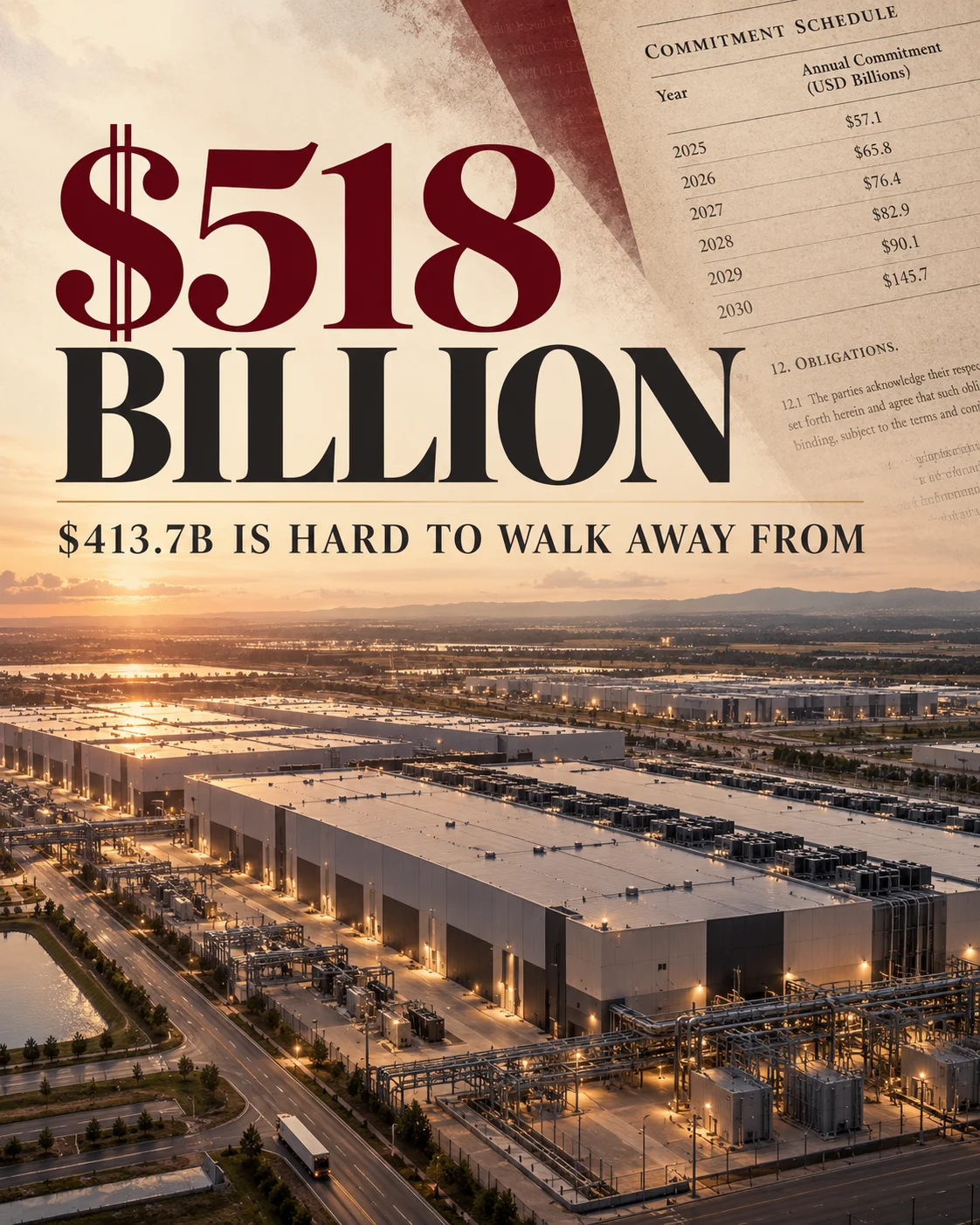
It covers roughly a decade of planned AI infrastructure spending across six partners. Anthropic says about 80% of that total is locked in already.
Reuters reported the number from a confidential IPO prospectus. Locked in means non-cancelable, or payable no matter how much of the capacity Anthropic actually uses. That is a different promise than a company simply saying it plans to spend money someday.
Where does the $413.7 billion actually come from?
Four commitments make up almost all of it. Add them up and they land within a tenth of a percentage point of Anthropic's own 80% figure.
| Partner | Commitment | Term |
|---|---|---|
| $111.1 billion | Through July 2033 | |
| Amazon | $110.0 billion | Through April 2036 |
| Microsoft | $31.4 billion | 7-10 years, non-cancelable except uncured breach |
| Broadcom (equipment leases) | $161.2 billion | Largely non-cancelable |
| Total | $413.7 billion | 79.9% of $518 billion |
The Google and Amazon deals both include a make-whole clause. If Anthropic's actual spending falls short of the minimum, it has to pay the difference anyway, according to Reuters. The Microsoft commitment can only be canceled if Microsoft itself commits an uncured material breach.
Why is this the opposite of the ghost-demand problem?
Because these numbers are contractual, not aspirational. Grid planners in Texas have spent months sorting real demand from developers merely reserving a spot in line.
Anthropic's filing sits at the other end of that spectrum. A company announcing it wants infrastructure is making a plan. A company agreeing to pay a fixed minimum for seven to ten years, whether it uses the capacity or not, has made an obligation. The Google and Amazon dates alone stretch to 2033 and 2036.
Free CPA AI Policy Checklist
Before staff paste client data into AI, check the rules your firm is missing.
Get the free checklist and join the Dispatch for practical AI controls, vendor questions, and client-data safeguards for accounting teams.
Free. No spam. You will also get the Nexairi Dispatch.
Why does it matter that Anthropic's partners are also its competitors?
Because the same three companies play several roles at once, and their interests don't all point the same direction. Anthropic says so directly in its own filing.
Google, Amazon and Microsoft are each investors in Anthropic, infrastructure suppliers to Anthropic and companies that distribute Claude to customers. All three also build and sell their own competing AI products. Anthropic's prospectus states that this mix of roles means its partners' incentives "may not be fully aligned" with its own.
That is a useful reminder that the AI industry isn't a clean lineup of rivals. It is closer to a small number of companies that fund each other, supply each other, distribute for each other and compete with each other, sometimes in the same contract.
Picture what that looks like from inside a renewal meeting. Anthropic's team negotiates cloud capacity pricing with Google's sales division while, a floor away, Google's own Gemini team is trying to win the same enterprise customers Anthropic is chasing with Claude. Both conversations happen at the same company, on the same week, and neither side can fully ignore the other. That is the arrangement Anthropic is locking in for seven to ten years.
Is the $84.5 billion xAI deal the same kind of risk?
No, and that distinction matters more than the headline number suggests. Anthropic's xAI agreements could reach $84.5 billion, but they are largely cancelable with 90 days' notice.
That $84.5 billion buys Nvidia-based computing capacity through 2029, according to Reuters. A commitment you can walk away from in three months carries a different kind of risk than one you owe for a decade regardless of usage. Lumping every AI spending number into one bucket hides that difference. Announced, contracted, financed and operating are not the same word, even when the dollar figures look similar.
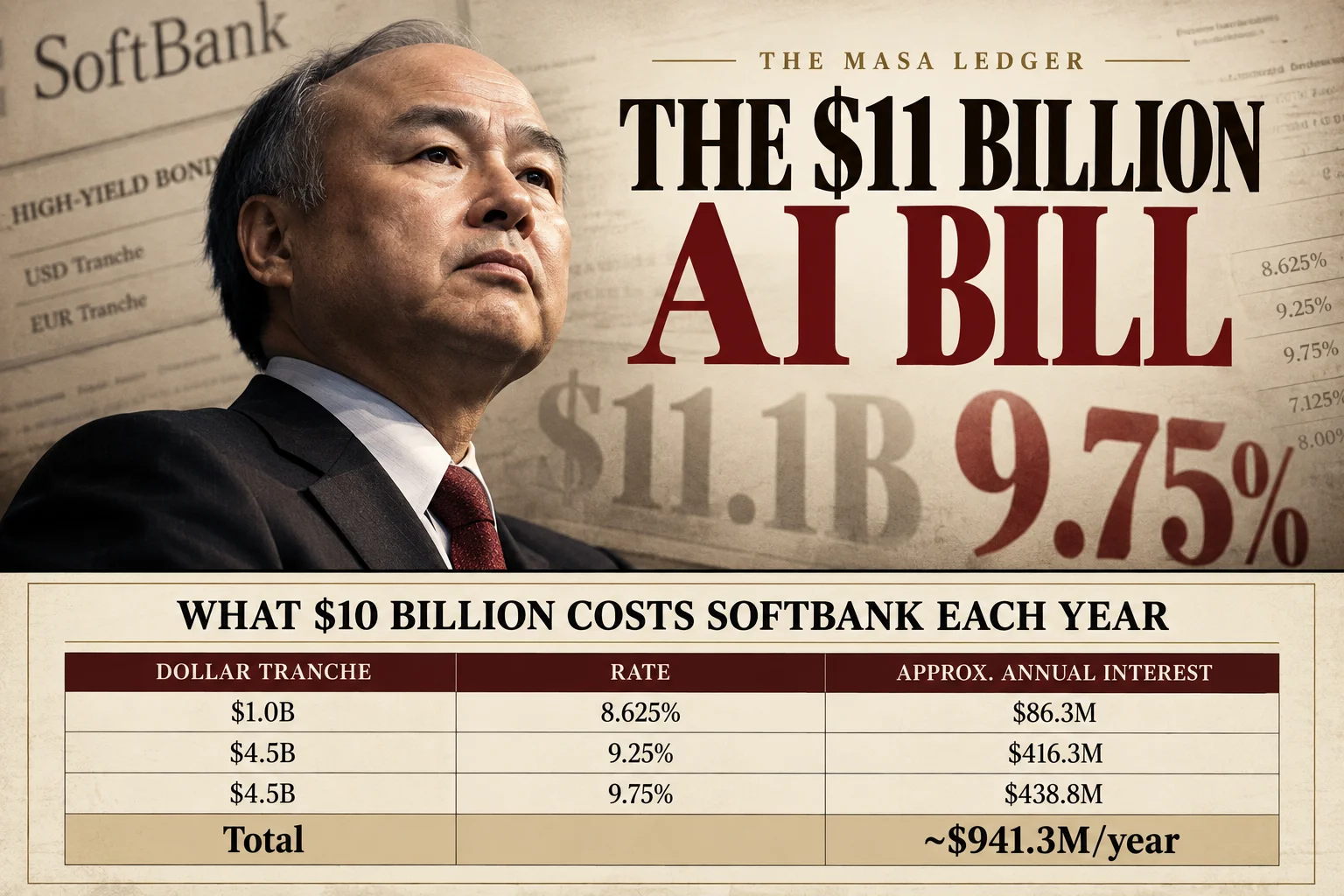
Anthropic isn't the only AI lab learning this lesson in public this month. SoftBank recently sold $11.1 billion of bonds at rates up to 9.75% to help fund its own AI commitments, a reminder that whether a company raises cash through debt or through long-term supply contracts, the bill still shows up on a fixed schedule. The financing method changes. The obligation to pay on time doesn't.
What this bet actually rests on
Anthropic told investors it is shifting away from relying only on cloud providers and toward its own dedicated data centers and directly leased chips, arguing that future growth will be limited by available computing power rather than a lack of demand for its products. That is a bet that Claude's usage keeps climbing and that compute stays scarce enough to justify locking in capacity years ahead of needing it.
If that forecast holds, prebooking capacity years in advance looks smart in hindsight. If model efficiency improves faster than expected, or competitors push compute prices down, or demand comes in lower than projected, the same non-cancelable contracts turn from an advantage into a fixed cost Anthropic has to carry anyway. A company that began as a research lab is now carrying the balance sheet of an infrastructure operator, with the fixed obligations that role requires. That shift doesn't happen by accident. It happens because Anthropic decided owning the pipeline mattered more than staying light on assets, and it accepted the downside that decision carries along with the upside.
What should investors and finance teams watch next?
Skip past the $518 billion headline and check the terms underneath it. A make-whole commitment and a 90-day cancelable agreement are not the same risk, even at similar dollar size.
If you work in finance or evaluate AI vendors for a living, the same test applies closer to home. Ask any AI supplier how much of its own infrastructure spending is contracted versus optional, and over what years it comes due. That answer says more about the company's staying power than its usage numbers do. It also tells you what happens to that vendor's pricing if its own bet on demand runs ahead of reality, a cost that tends to land on customers eventually, not just shareholders.
Sources
Related Articles on Nexairi
Free Assessment
Is your firm ready for AI?
A 5-minute governance check for CPA firms using ChatGPT, Copilot or AI accounting software. Get your score and your top gaps — free.
Jim Smart is the founder and editor in chief of Nexairi. A Business Intelligence Developer with experience building data systems for Verizon, U.S. Army operations, and enterprise finance teams, Jim spent years turning complex data into decisions that executives could act on — dashboards, forecasting models, and automation pipelines across telecom and government contracting. He founded Nexairi to apply that same clarity to AI: making emerging technology understandable and actionable for the operators, accountants, and business owners who need it most. Jim holds GenAI certifications from the University of South Florida Bellini College of AI and completed Springboard's Data Science Career Track.