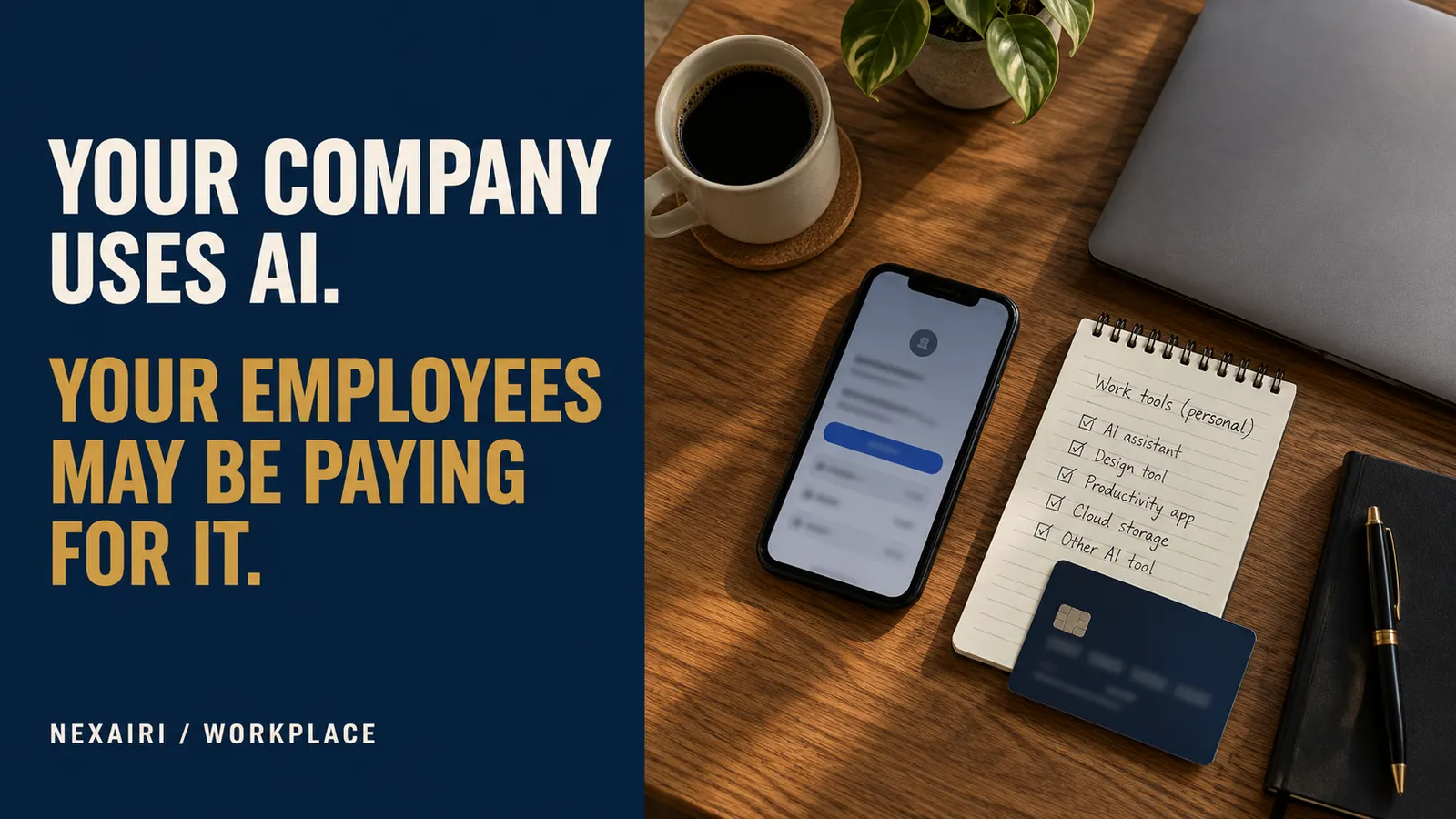
Why are employees paying for their own AI tools?
Nobody made them wait. British workers now spend £958 million a year of their own money on AI tools for work, Deloitte UK found.
Ipsos polled 25,000 workers for Deloitte between May and June 2026. Two-thirds had tried tools like ChatGPT, Claude, Gemini or Copilot. Nearly a quarter used one daily. And 17% of users, roughly one in six, paid for at least one of those tools out of pocket.
That is not how companies usually buy software.
Nobody expects an accountant to buy their own copy of Excel because spreadsheets make the job faster. A designer doesn't quietly expense an Adobe subscription because the design team hasn't gotten around to approving one. When a company decides an employee needs a tool, the company buys the tool.
AI broke that pattern. ChatGPT, Claude and Gemini showed up first as consumer products that happened to be useful at work. An employee could spend $20 or $30 a month, start using one that afternoon and skip the usual procurement request entirely. The friction was close to zero. So people paid it themselves.
What does "AI adoption" even mean if the worker bought the tool?
It means the usual adoption stat measures the wrong thing. A company reporting 60% AI usage can hide two very different stories.
Did the company roll out an approved system, have IT integrate it and redesign a workflow around it? Or did an employee notice that Claude writes a decent first draft and start paying for it themselves? One of those is organizational change. The other is a personal productivity hack that happens to be running inside the company's building.
Both produce real work. Only one tells you whether the organization itself has figured out AI. If the honest answer to "who deployed this?" is "the employee," the company may be capturing AI's productivity gains without having built any AI capability of its own.
The hidden economics of employee-funded AI
A $25 monthly AI subscription costs $300 a year. It can return dozens of extra work hours to an employer who never paid for it.
If that tool saves 70 minutes a week, which is what Deloitte's survey found on average, the employer gets back dozens of hours of extra output over the year, and the worker is the one who paid for it.
That is not automatically exploitation. People buy their own keyboards, notebooks and headphones because those things make work easier too. AI is a different case because the tool doesn't just make the job more comfortable. It can directly raise how much work one person produces.
Multiply a $300 personal AI budget across a workforce of ten thousand people and you get $3 million a year in productivity spending that never shows up on the company's technology budget.
| Signal | Company-deployed AI | Employee-funded AI |
|---|---|---|
| Who chose the tool | IT or a department lead, after review | The individual worker |
| Who pays | The employer, on a technology budget line | The worker, out of pocket |
| Who sees the usage | IT, security, finance | Often no one but the worker |
| What it tells leadership | The organization has built AI capability | Workers found value the company hasn't captured yet |
Free CPA AI Policy Checklist
Before staff paste client data into AI, check the rules your firm is missing.
Get the free checklist and join the Dispatch for practical AI controls, vendor questions, and client-data safeguards for accounting teams.
Free. No spam. You will also get the Nexairi Dispatch.
What is shadow AI, and why is nearly a third of usage hidden?
Shadow AI means using generative AI at work without telling your employer. Deloitte found 31% of GenAI users do exactly that, with no formal training.
It is not a fringe habit. Nearly a third of everyone already using GenAI at work falls into that category, and half of all users say no one ever showed them how to use it safely.
That raises the obvious security questions around confidential information, client data and intellectual property. It also creates a quieter management problem. A company can't redesign a workflow around a tool it doesn't know its own staff are using. It can't train people properly, compare tools or set sensible rules about what information belongs in the system.
Deloitte's head of industry insight, Paul Lee, put it plainly: "The story here isn't that workers are using GenAI, it's that they are using it despite limited training, patchy guidance and, in some cases, without their employer's knowledge." Shadow AI usually gets filed under governance failure. It's also an information failure. Employees may be running hundreds of small experiments that management never sees, and some of those experiments are probably showing exactly where the next real productivity gain is hiding.
Should companies pay for employee AI subscriptions?
Yes, eventually, most companies should pay. Funding the subscription alone will not fix what is broken in the workflow it quietly replaced.
Deloitte's chief AI officer for the UK, Hayley McKelvey, framed the real challenge this way: "The challenge is no longer getting people to use GenAI, it's how businesses meet this growing demand in a way that is secure, responsible and creates lasting value."
Meeting that demand starts with treating employee-funded AI as a signal instead of a compliance problem to shut down. If people are willing to pay $20 or $30 a month because the company-provided workflow is slower, that tells you something useful about where the workflow is broken.
The pilot already happened. Companies just weren't running it.
The instinct after reading a survey like this is to write a policy. Do that, but a policy alone won't close the gap Deloitte is describing. The more useful move is to ask employees what they bought, what they use it for, what they stopped doing by hand and what information they've been putting into it. Then decide, tool by tool, whether to provide an approved version, redesign the workflow around it or tell staff that a specific use is too risky to continue informally.
The companies that figure this out first won't be the ones that spent the most on enterprise AI contracts. They'll be the ones that noticed their own employees had already run the pilot, paid for it themselves and were just waiting for someone in leadership to ask what they'd found.
For years, the AI spending story has been told through corporate budgets: data centers, GPUs, enterprise licenses. Deloitte's survey opens a second ledger, and on it, almost £1 billion sits in employees' own accounts. If you run a team, the useful next question isn't whether your people are using AI. It's what they bought, and why your workflow didn't beat them to it.
For more on how the gap between AI adoption claims and AI capability is showing up across enterprise finance and operations, see our coverage of why seat counts are the wrong way to measure real AI usage and why AI sold as software keeps needing armies of engineers to actually work.
Sources
Related Articles on Nexairi
Free Assessment
Is your firm ready for AI?
A 5-minute governance check for CPA firms using ChatGPT, Copilot or AI accounting software. Get your score and your top gaps — free.
Jim Smart is the founder and editor in chief of Nexairi. A Business Intelligence Developer with experience building data systems for Verizon, U.S. Army operations, and enterprise finance teams, Jim spent years turning complex data into decisions that executives could act on — dashboards, forecasting models, and automation pipelines across telecom and government contracting. He founded Nexairi to apply that same clarity to AI: making emerging technology understandable and actionable for the operators, accountants, and business owners who need it most. Jim holds GenAI certifications from the University of South Florida Bellini College of AI and completed Springboard's Data Science Career Track.