What did Google actually commit to in Finland?
Google pledged about $15 billion for Finnish data centers and, in the same breath, locked in the electricity to run them through a 22-year nuclear contract.
The headline is the money. Google plans to spend at least €13 billion, roughly $15 billion, on data centers and related infrastructure in Finland over the next two years. The sites are in Hamina, Kajaani, Muhos and Vaala.
The part worth your attention is underneath. Google signed a 22-year power purchase agreement with the Finnish energy company Fortum. A power purchase agreement is a long contract to buy a set share of a plant's electricity at agreed terms. This one starts in 2028 at a reduced volume and then covers half of the output from Fortum's Loviisa nuclear plant from 2030 through 2049. Google also backed a 94-megawatt battery storage system near its Kajaani data center. It is due online in late 2027. New onshore wind deals bring Google's contracted Finnish wind capacity to 629 megawatts.
So Google did not just announce more computing capacity. It started nailing down the power system that capacity depends on.
The AI story is turning into an energy story
Why does a power contract say more than a model launch? Because a company can buy chips in months, and a country cannot build a power plant or a transmission line that fast.
For the last few years the AI conversation has opened with chips. How many GPUs. Which model. How fast. What the newest chip costs. Those questions still matter. The bottleneck is just moving.
Chips ship on a purchase order. A nuclear plant, a new line of high-voltage transmission or a grid upgrade takes years and a stack of permits. When the scarce thing shifts from silicon to electricity, the real constraint moves with it. Grid capacity, not chip supply, is now the thing that sets the schedule.
Loviisa shows why the contract matters. The plant is not new. Its two reactors have run since the late 1970s and early 1980s. Fortum wants to keep them going to 2050, but that means a long and expensive upgrade program, and a large slice of that work still waits on a final investment decision. A 22-year buyer changes that math. If Fortum knows Google will take the power, spending the money to keep the plant alive is far easier to justify. Without a deal like this, the reactor most likely stops in 2030.
That is a sturdier signal than a press release saying a firm might need several gigawatts someday. Google put a two-decade contract behind the demand.
Announced demand and committed demand are not the same thing
Announced demand is a number in a slide deck. Committed demand has a signed contract, equipment on order and a named power partner behind it.
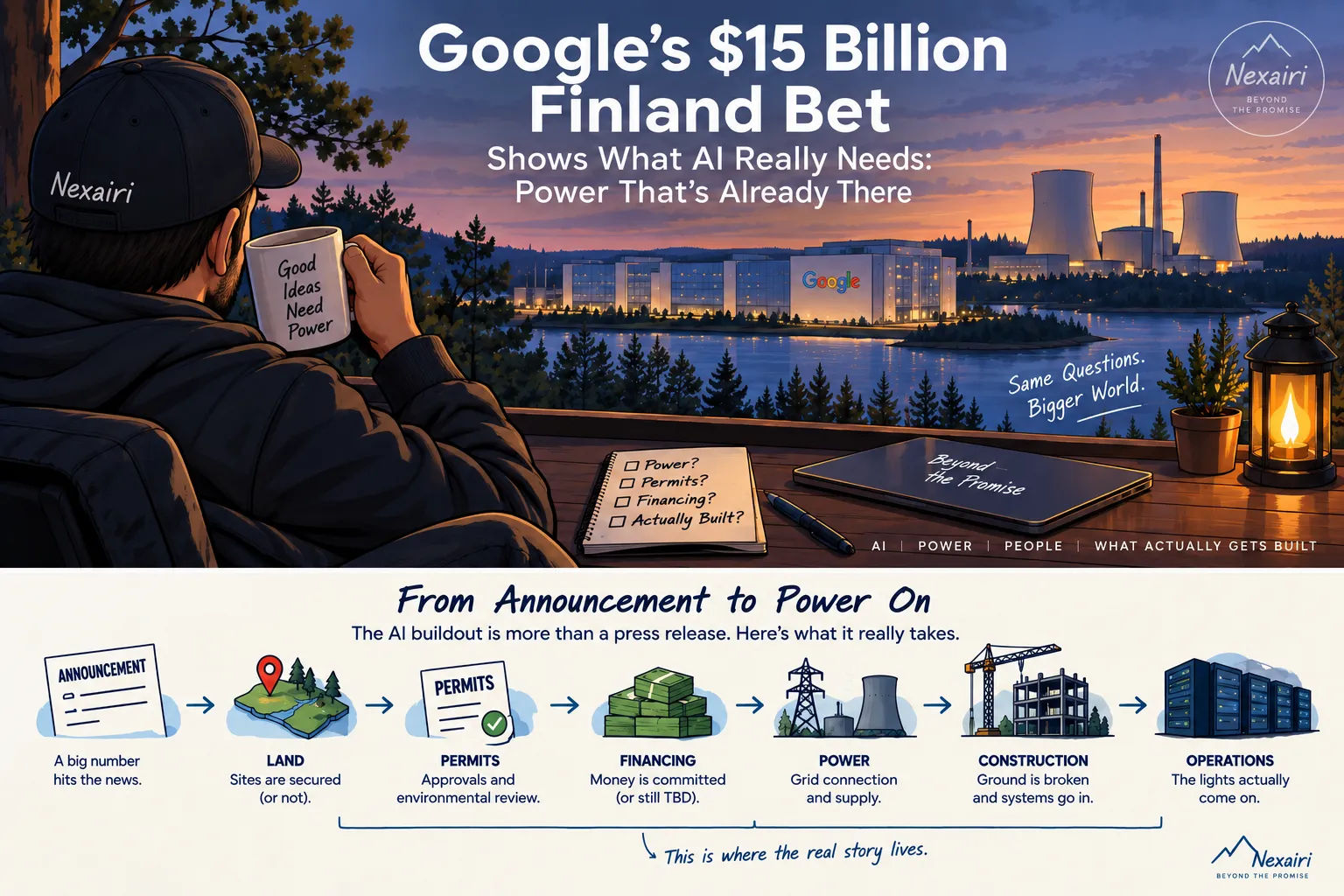
Nexairi has been tracking the gap between what AI developers announce and what they actually commit to. A developer can reveal a data center before it has the land, the permits, the power, the customers or the financing to finish it. That is why grid operators in the United States started asking harder questions about giant hookup requests.
We saw the extreme version in Texas, where data centers and other large users have asked the grid for 474 gigawatts of power, up from about 48 gigawatts in 2023. Utilities call much of that ghost demand, and when a few of them added collateral rules, large parts of the pipeline vanished within months. The Finland deal is the contrast case. Google already runs in the country. It has used a converted paper mill in Hamina as a data center for more than a decade, cooled with seawater from the Gulf of Finland. Now it is pairing fresh spending with a signed nuclear contract, a battery under construction and wind deals.
That does not guarantee every euro of the €13 billion arrives on time. Big projects still slip. But this one has moved well down the line from "we want power" toward "we have contracts and equipment behind the power."
How is this different from xAI's power fight in Memphis?
Same problem, opposite playbook. xAI solved its power crunch after the fact with on-site gas turbines and a local backlash. Google solved it in advance with a contract.
Our Elon's Interplanetary Stack series walked through xAI's scramble to power its Colossus supercomputer in Memphis. xAI wanted to push training compute toward roughly 2 gigawatts. The grid could not serve that fast. So the company leaned on gas turbines, some of them running before the permits caught up. That drew complaints from residents and environmental regulators. Tesla Megapack batteries filled gaps. It worked, but it was a fight.
Google in Finland is running the other way around. Instead of bolting generation onto a site under deadline pressure, it signed a 22-year deal to keep an existing low-carbon plant open, then added storage and wind on top. One approach reacts. The other plans. Both start from the same fact: compute can be bought faster than clean, permitted power can be built.
Google is not alone in playing this forward. It has a 25-year agreement with NextEra to restart Iowa's shuttered Duane Arnold nuclear plant, a deal the US Department of Energy just backed with a loan of up to $1.9 billion. The pattern is a tech company acting as a power customer, a project financier and, in effect, a developer, all at once.
| Marker | Announced (a 474 GW grid queue) | Committed (Google in Finland) |
|---|---|---|
| Power contract | None, or a letter of intent | 22-year PPA covering half of Loviisa's output to 2049 |
| Equipment | Nothing ordered | 94 MW battery under construction near Kajaani |
| Site | Land option, or a slide | Operating Hamina site since about 2011, plus three more |
| Grid partner | Unnamed | Fortum, with plans for more nuclear, wind and grid flexibility |
Why Finland, and why it may be the template
Finland offers several things AI operators want at once. A low-carbon grid. Cool weather that cuts cooling costs. Local operating experience for Google. Industrial sites and energy infrastructure already in place. The Hamina paper mill turned data center is the clearest example of that reuse.
That is less dramatic than a new campus in the desert. It may also be the better picture of where the next phase goes. The winning site may not be the one with the biggest announcement. It may be the one where power, land, cooling and grid connections already line up. If that holds, expect more tech-company money flowing into old nuclear plants and grid upgrades. Expect fewer clean-slate megaprojects announced without a power plan attached.
The old model was simple. Utilities built plants. Big customers bought from the grid. The AI buildout is blurring that line, because for a hyperscaler, waiting for power to show up has become a business risk worth spending billions to remove.
What should you watch next?
Watch how much of the €13 billion turns into active construction. Watch how fast the new sites clear permits and grid work. Watch whether other countries copy the model.
A few open questions will tell you whether this is a finished story or a plan. How much of Google's spending becomes real construction over the next two years. How quickly the Finnish sites move through permitting and grid connection. Whether the Fortum partnership adds new nuclear capacity or mainly extends the plant that already exists. Whether Finland becomes a route other governments try to sell to hyperscalers.
There is also a smaller test you can run yourself. Next time you read about a data-center megaproject, look past the capex number. The same goes when you size your own AI roadmap against projected demand. Ask what has a signed contract. Ask what has real budget rather than hoped-for budget. Ask what has cleared an actual approval gate. Google can plan for almost unlimited compute. The physical world still sets the calendar. A 22-year power contract is Google admitting it.
Sources
- World Nuclear News: "Google signs up for electricity from Finnish nuclear power plant"
- Helsinki Times: "Google invests €13bn in Finland and plans three new data centres"
- Data Center Dynamics: "Google signs nuclear PPA with Fortum in Loviisa, Finland"
- Data Center Dynamics: Google, NextEra and the Duane Arnold nuclear restart
- Reuters: "Texas' halt on powering data centers reflects US reckoning over 'ghost' demand"
Related Articles on Nexairi
Jim Smart is the founder and editor in chief of Nexairi. A Business Intelligence Developer with experience building data systems for Verizon, U.S. Army operations, and enterprise finance teams, Jim spent years turning complex data into decisions that executives could act on — dashboards, forecasting models, and automation pipelines across telecom and government contracting. He founded Nexairi to apply that same clarity to AI: making emerging technology understandable and actionable for the operators, accountants, and business owners who need it most. Jim holds GenAI certifications from the University of South Florida Bellini College of AI and completed Springboard's Data Science Career Track.