What did SoftBank actually pay to raise $11.1 billion?
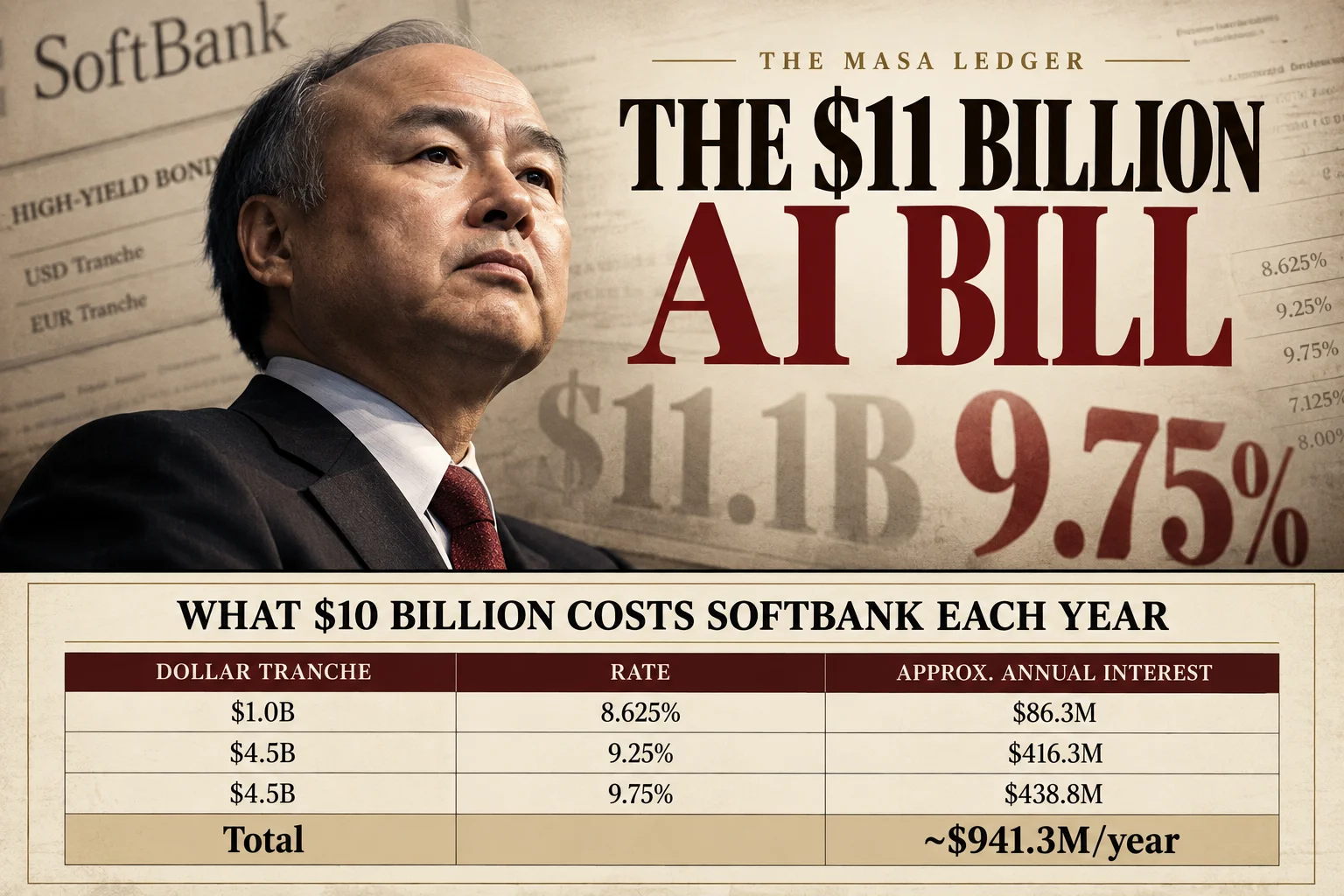
SoftBank paid up to 9.75% a year on its longest dollar bond. The size of the sale grabbed the headlines, but the rate is the number to read.
Masayoshi Son's company sold $10 billion of dollar bonds in three pieces. Then it added two euro pieces worth €500 million each. Reuters reports the sale is the largest high-yield corporate bond deal ever. Investors showed up. Satoru Aoyama, a senior director at Fitch Ratings, told Reuters he was "positively surprised by the market appetite."
Appetite has a price, though. Here is what the dollar bonds cost each year.
| Amount | Term | Rate | Interest per year |
|---|---|---|---|
| $1.0 billion | 3.5 years | 8.625% | $86.25 million |
| $4.5 billion | 5.5 years | 9.25% | $416.25 million |
| $4.5 billion | 7.5 years | 9.75% | $438.75 million |
| $10.0 billion | $941.25 million |
The interest column is our own arithmetic from the coupons Reuters reported. The euro bonds pay 7.125% and 8%, which adds roughly €76 million more. That is close to $1 billion a year in interest before SoftBank repays a dollar of principal.
Why does 9.75% matter more than $11.1 billion?
Because a coupon is a fixed promise to pay, however the business is doing. Big AI numbers blur together. Interest does not.
Picture a controller reviewing a customer whose new loan carries a 9.75% rate. Nobody on that call asks whether the customer believes in its plan. They ask how much cash comes in each month to cover the payment. Bond investors are asking SoftBank the same question, and the price they charge is their answer.
The comparison with 2021 sharpens it. When SoftBank sold $7.3 billion of senior dollar and euro bonds that June, the yields ran from 2.125% to 5.25%. The new bonds run from 7.125% to 9.75%. The cost of insuring SoftBank's debt against default has also climbed. Reuters reports the five-year credit default swap spread topped 400 basis points this week, against about 280 in June.
None of this proves investors doubt the strategy. They lent $11.1 billion, after all. The fair reading is narrower: the money is available, but it is no longer cheap.
What is SoftBank borrowing for?
SoftBank is borrowing to own more of the AI supply chain, and OpenAI is the biggest piece.
Reuters says SoftBank has committed $64.6 billion to the ChatGPT maker and will hold roughly 13% of it by next week.
OpenAI is not the only bet. SoftBank agreed to buy ABB's robotics business in a $5.4 billion deal and has said it will acquire DigitalBridge, a digital infrastructure investor. It still owns the majority of Arm, the chip designer. It also runs SB Energy, its data center development company.
Put those pieces side by side and a pattern shows up. SoftBank is not just buying shares in AI companies. It is collecting the parts underneath them: models, chips, power, data centers and robots. That can be worth a great deal if the bet pays off. It also means the bills arrive on a schedule the bets do not control.
There is a plain difference between owning a company and lending to it. A shareholder can wait through a slow year. A bondholder cannot, because the coupon comes due on its date. That is why SoftBank's rate table reads differently from its list of investments. The investments show what SoftBank believes. The coupons show what it owes.
The maturities matter too. The dollar bonds come due in 3.5, 5.5 and 7.5 years. Every one of those dates falls well before a 20-year data center lease has run its course, so SoftBank will need fresh cash or new borrowing along the way. Refinancing is not a problem in itself. It does depend on lenders feeling as open in 2030 as they do today.
Free CPA AI Policy Checklist
Before staff paste client data into AI, check the rules your firm is missing.
Get the free checklist and join the Dispatch for practical AI controls, vendor questions, and client-data safeguards for accounting teams.
Free. No spam. You will also get the Nexairi Dispatch.
Who builds, who supplies, who uses and who lends?
The Ohio data center project shows the whole chain on one page. It is a useful map for reading any AI financing headline.
In August, Nvidia announced it would invest $1.5 billion in SB Energy and provide credit support on land, power and shell construction at the PORTS-Pike Technology Campus in Pike County, Ohio. Nvidia will be the exclusive AI compute provider at the site. SB Energy will build, own and operate the data center under a 20-year lease to OpenAI.
Read it as four roles. SoftBank's companies build. Nvidia supplies the computing platform. OpenAI uses the capacity. Lenders and outside investors pay for much of it up front, and they expect interest back on a set date.
That fourth role is the one that has grown. Reuters, citing LSEG data, says bond sales by the biggest cloud companies (often called hyperscalers) have more than doubled this year to over $200 billion. The early phase of the AI boom ran on promises: huge sites, huge budgets and huge demand forecasts. The current phase runs on debt, and debt asks a plainer question.
The question financing forces
Does what is being built earn enough to pay for what is being built? Nobody can answer that today. OpenAI's revenue, the lease terms and each borrower's other cash sources all matter, and much of that is private. What can be said is that the question now has a price attached, and SoftBank's coupons are one public measure of it.
A high rate is not a verdict. Plenty of healthy companies pay high rates for growth capital. The useful habit is to stop treating investment totals as the story and start reading the financing terms next to them.
What should you check when the next AI deal lands?
Look past the total to the rate and the maturity. Then ask who signed the lease. Those show how much room the borrower has if revenue arrives late.
If you work in finance, this is also a supplier and customer question. A vendor that leans on high-cost debt has less slack if demand softens, and a contract that depends on that vendor inherits the risk. Ask how the vendor's AI capacity is funded, not just what it costs you.
The next data point comes soon. SoftBank now has to put the $11.1 billion to work, and we will watch what it spends and what that money costs it while the industry finds out whether the map holds. A good next read: compare the coupon on any big AI bond against what that borrower earns today.
Sources
Related Articles on Nexairi
Free Assessment
Is your firm ready for AI?
A 5-minute governance check for CPA firms using ChatGPT, Copilot or AI accounting software. Get your score and your top gaps — free.
Jim Smart is the founder and editor in chief of Nexairi. A Business Intelligence Developer with experience building data systems for Verizon, U.S. Army operations, and enterprise finance teams, Jim spent years turning complex data into decisions that executives could act on — dashboards, forecasting models, and automation pipelines across telecom and government contracting. He founded Nexairi to apply that same clarity to AI: making emerging technology understandable and actionable for the operators, accountants, and business owners who need it most. Jim holds GenAI certifications from the University of South Florida Bellini College of AI and completed Springboard's Data Science Career Track.