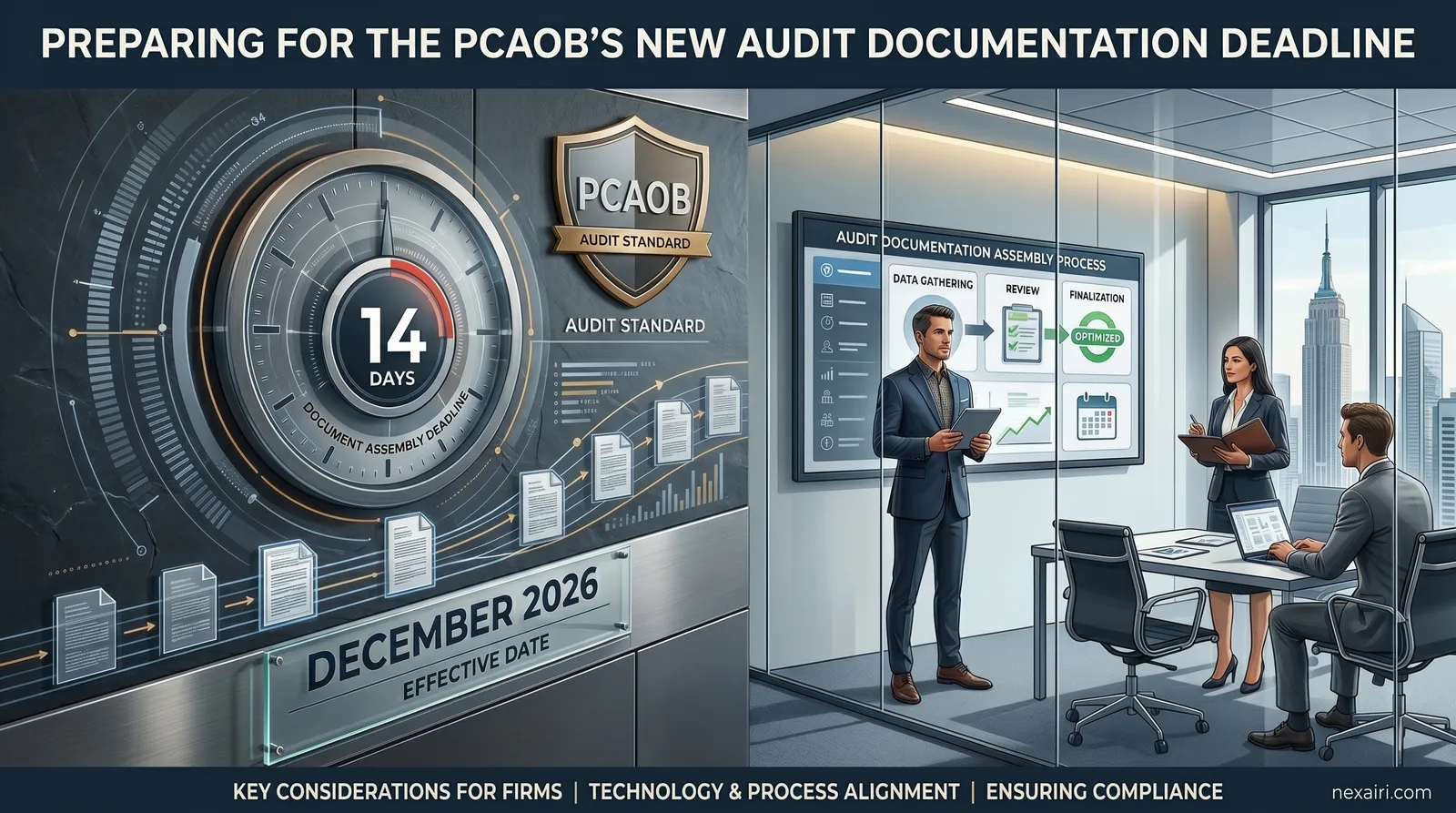
The PCAOB documentation clock is not a back-office detail. It changes when audit teams have to finish the work.
PCAOB's AS 1215 page for the December 15, 2026 effective version says the final set of audit documentation should be archived no more than 14 days after the report release date. More important, paragraph .15 says the necessary audit procedures, sufficient evidence and supervisory reviews must be completed before the report is released.
That means the real deadline is earlier than the archive date. If your team still treats documentation cleanup as something that happens after issuance, the workflow needs to change.
What exactly changed in AS 1215?
The key change is timing: supervisory review must finish before report release, and archive assembly shrinks to 14 days.
AS 1215 governs audit documentation for engagements performed under PCAOB standards. The amended page effective December 15, 2026 keeps the core purpose intact: documentation must support the auditor's representations, show the work performed and create a clear link to significant findings or issues.
The timing is the operational issue. Paragraph .15 says that before the report release date, the auditor must have completed necessary procedures and obtained sufficient evidence, and the engagement partner and other supervisors must have completed their documentation reviews.
It then says a complete and final set of audit documentation should be archived no more than 14 days after report release. The SEC approval order for PCAOB amendments describes the change from a 45-day completion period to 14 days.
The partner message should be blunt: "If the file is not ready for review before release, the report is not ready for release." That is the operating change hidden inside the date math.
Who is affected?
This matters to firms conducting engagements under PCAOB standards, including issuer audit work and other covered engagements.
It is especially important for smaller PCAOB-registered firms because compressed documentation windows expose scheduling weaknesses. A large firm may have centralized tools and dedicated engagement support. A smaller firm may have the same manager reviewing several jobs at once, with documentation cleanup happening in gaps between client calls.
The standard does not care that the calendar is crowded. The file still has to show what was done, who reviewed it and when.
What changes in daily audit workflow?
The main change is that supervisory review has to move before report release, not after.
If the team issues first and cleans up later, the process is backwards for the amended workflow. Open review notes, missing evidence, unresolved consultation memos and weak cross-references need to be addressed before the report goes out.
That changes engagement scheduling. Partners and managers need review time on the calendar before release. Staff need earlier cutoffs for workpaper completion. Engagement teams need a short pre-release file check that confirms procedures, evidence, conclusions and reviews are complete.
| Old habit | New control | Owner |
|---|---|---|
| Clean up workpapers after issuance | Pre-release documentation freeze | Engagement manager |
| Review notes stay open until archiving | No report release with unresolved supervisory review items | Engagement partner |
| Archive date managed by admin | 14-day archive tracker tied to report release | Firm quality control owner |
Where will smaller firms feel the squeeze?
Smaller PCAOB-registered firms will feel the squeeze in handoffs that already run late or depend on after-release cleanup.
One common example is a manager who performs final review after the client has approved the financial statements but before the file is archived. Under the amended workflow, that timing is too loose if significant procedures, evidence or supervisory review remain incomplete at report release. Another example is a partner who waits to clear final review notes after issuance because the team is already moving to the next engagement. A third is a component-auditor package that arrives with enough support to issue, but not enough organization for a clean archive file.
These are not paperwork preferences. They are evidence problems. AS 1215 says documentation should clearly demonstrate the work performed, who performed it, who reviewed it and the date of review. If those details are scattered or late, the firm is relying on memory at the exact moment the standard is asking for a record.
How should firms prepare before December 15?
First, map every PCAOB engagement against the 14-day archive window. Do not assume the current schedule works. Test it against the release date, partner review availability and holiday calendar.
Second, move supervisory review to pre-report signoff. The file should show who reviewed the work and when. If the review evidence appears after report release, the firm has a documentation story it may not want to tell later.
Third, update the engagement completion checklist. Add a pre-release signoff for open items, significant findings, consultations, accumulated misstatements, management representations and audit committee communications where applicable.
Fourth, run one dry run before the effective date. Pick a completed engagement and ask whether the team could have archived the final file within 14 days without late cleanup. The answer will show where the workflow breaks.
What should go into the dry run?
The dry run should test one real file against the 14-day archive clock and pre-release review rule.
Start with one issuer audit file and use the actual report release date. Count 14 calendar days. Then ask whether the file would have been ready for archive without deleting, discarding or reconstructing anything after the deadline. Review the engagement completion document, unresolved review notes, evidence cross-references, consultation records, accumulated misstatement schedule, representation letters and audit committee communications.
Next, look for bottlenecks by role. If staff sections were late, move the internal deadline. If manager review was late, protect review time before release. If partner review notes were vague, define what must be cleared before permission to use the report is granted. If outside component documentation was thin, change the request list and due date.
The output should be a one-page transition memo. It should name the recurring delays, the new deadline owner and the first engagement that will use the revised schedule.
What does this mean for your firm?
For firms, the amended timing turns documentation readiness into a capacity planning and release-control issue.
Partners should ask four questions now: Which engagements will fall near the transition? Which managers own final review? Which file sections regularly lag after release? Which quality-control procedures need new timing?
Quality-control owners should ask one more question: does the firm's current inspection process reward clean files after archive, or does it verify that review was actually finished before report release? The distinction matters because the amended timing makes late cleanup less defensible.
Nexairi covered a similar regulatory-action pattern in FASB Carbon Credit Rules: What CPA Firms Should Check. The lesson is the same here. Standards changes become expensive when firms wait until the first live deadline to change the workflow.
The safest move is to treat December 15 as a scheduling deadline, not just an effective date.
| Timing | Firm action | Evidence to retain |
|---|---|---|
| Before report release | Clear procedures, evidence, consultations and supervisory review notes. | Pre-release signoff showing who reviewed what and when |
| Days 1-3 | Run the final file check against the report release date. | Archive tracker opened with responsible owner |
| Days 4-7 | Confirm review-note clearance and cross-reference completeness. | Closed review notes and updated evidence index |
| Days 8-11 | Validate the archive package without adding new audit evidence. | Retention package checklist |
| Days 12-14 | Lock the final documentation package for retention. | Final archive date and lock confirmation |
This is the kind of rule change that looks small until the first file runs late. The firms that handle it well will not be the ones that sprint during the 14-day window. They will be the ones that move review earlier, while there is still time to fix the work instead of explain why it was cleaned up late.
Scope note: This article summarizes public PCAOB and SEC materials. It is not legal, audit or professional standards advice for a specific engagement.
Sources
Related Articles on Nexairi
Free Assessment
Is your firm ready for AI?
A 5-minute governance check for CPA firms using ChatGPT, Copilot or AI accounting software. Get your score and your top gaps — free.
Sydney Smart is a Certified Public Accountant, Fractional CFO, and Controller with over 17 years of experience across public accounting and corporate finance. She holds a Master's degree in Taxation from Georgia State University, is a licensed CPA through the Georgia Society of CPAs, and is a certified QuickBooks Pro Advisor. Sydney spent 13 years as a Senior Tax Manager at Hungeling CPA preparing and reviewing hundreds of tax returns annually for corporate, partnership, and individual clients before moving into corporate controller roles. As Founder of Simply Smart Consulting, she partners with founders and growth-focused businesses to build financial systems that scale — budgeting, cash flow forecasting, GAAP compliance, and real-time KPI reporting. She reviews Nexairi's accounting and finance coverage to ensure accuracy for the CPAs, CFOs, and operators who rely on it.