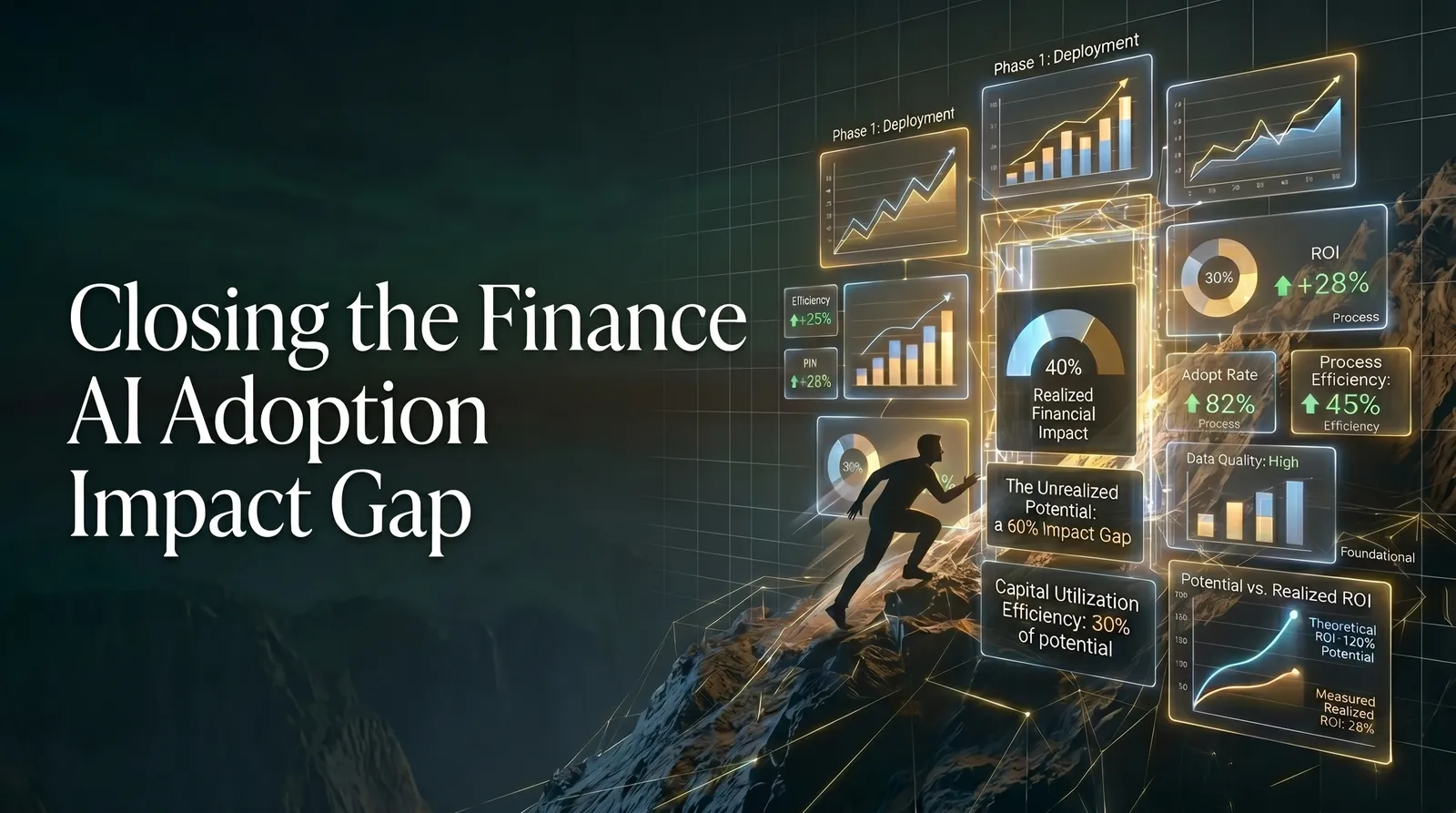
CFOs funded the AI revolution. The results, for most, have not arrived.
84% of finance organizations have implemented or are planning AI. Only 7% report high or very high impact on operations.
Gartner's June 2025 survey of 183 CFOs found 84% of finance organizations have implemented or are planning AI. Only 7% report high or very high impact on operations. A separate RGP survey of 200 U.S. finance chiefs found just 14% have seen clear, measurable impact. The Journal of Accountancy reported in April 2026 that 60% of finance teams are actively piloting AI, yet only 7% report strong workflow results from those pilots.
42% of companies walked away from AI initiatives in 2025. That's more than double the 17% that quit in 2024. They didn't run out of options. The tools got purchased, the pilots ran, and then someone asked for results. There weren't any.
The 77-point gap between adoption and measurable impact is not evidence that AI fails in finance. It is evidence that adoption speed outpaced organizational readiness. CFOs who are seeing results are not using better technology. They are using technology on a better foundation.
What Finance AI Use Cases Actually Deliver?
AP automation and report generation lead all finance AI use cases on proven ROI, while strategic functions like FP&A forecasting remain too early-stage for most teams.
Accounts payable automation is the clearest win in finance AI right now. Adoption sits at 37%. For companies processing 500 or more invoices per month, payback typically arrives in 60 to 90 days. Report generation and commentary has reached 57% adoption with consistent user satisfaction across mid-market and enterprise teams. Anomaly detection runs at 34% adoption and produces fewer false positives than traditional rules-based systems.
The failure pattern starts when finance teams target strategic work first. FP&A forecasting is in full production at only 12% of finance teams. 53% of organizations do not use AI in forecasting at all. Journal entry automation sits below 5% adoption. The accuracy requirements and audit exposure are too high for most current tools to handle without significant human review overhead.
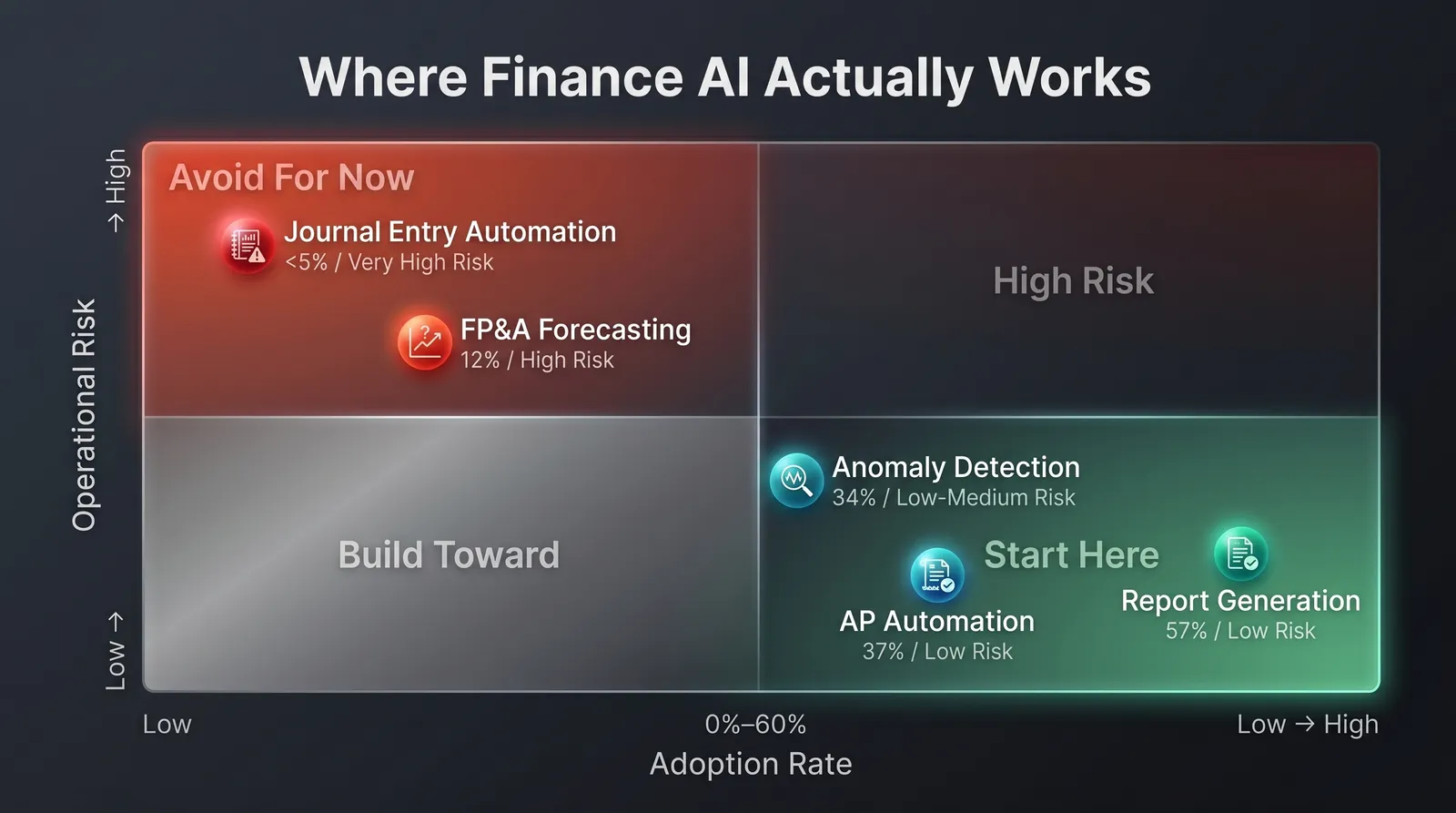
Finance teams win when they start with high-volume, repetitive work that has a clear right answer. They stall when they start with judgment-dependent work before they have the data quality and governance to support it. A failed forecasting pilot makes the next automation request harder to approve.
Why Do Finance AI Pilots Fail to Scale?
Most of the 77-point gap between AI adoption and measurable results comes down to three execution failures, and none of them involve the technology.
The first is data. KPMG's 2026 Global AI in Finance Report found 66% of AI vendors and 46% of regulators cite data availability and quality as the leading pain point in finance AI deployments. Pilots succeed because teams clean the data for the pilot scope. Scaling exposes everything underneath. If AP, general ledger and customer data do not sync cleanly, AI cannot produce accurate outputs at scale. Garbage in, garbage out is not a cliché in finance — it is the reason $2.3 billion in trading losses traced back to AI hallucinations in Q1 2026 alone.
The second is governance. Only 18% of banking leaders say they could pass an independent AI governance review in 90 days, per KPMG. Without documented approval workflows, audit trails and escalation procedures, autonomous outputs create liability. Finance leadership ends up signing off on results it cannot fully verify. That is how AI hallucinations become financial restatements.
The third is people. On average, 10% of AI project budgets go to change management. McKinsey research finds 70 to 85% of AI projects fail due to organizational issues, not the technology itself. Finance teams deploy the tool. Staff don't use it. The ROI measurement never appears. The pilot sits idle, the budget gets cut and the abandonment rate climbs another point.
The correct sequence is: clean data first, then process standardization, then governance, then automation. Most teams reverse this order. They purchase the tool before the foundation exists to support it.
Is Agentic AI in Finance Ready or Oversold?
99% of finance organizations plan to deploy agentic AI. Only 11% have actually done it.
Every major finance vendor is pitching autonomous workflows right now. Meanwhile, Cambridge Judge Business School and MIT Technology Review attribute $2.3 billion in Q1 2026 trading losses to AI hallucinations in financial analysis and reporting. 67% of AI vendors and 70% of regulators rank hallucinations as a top-two risk in their own category. The vendors selling autonomy and the regulators warning against it are often describing the same products.
Agentic AI in finance is real. It works inside organizations with documented governance, tested escalation procedures and clean, integrated data — what McKinsey's maturity research calls Stage 4. Most finance teams are at Stage 2 or Stage 3. Pushing agentic tools into a Stage 2 org is how errors reach the general ledger before anyone is watching.
CFOs waiting for better governance before deploying agentic AI are making the right call.
How Do You Know If Your Finance Team Is Ready for AI?
Finance teams that score below 30 on McKinsey's 2025 AI readiness index fail more than 70% of the time.
Before the next vendor demo, answer these eight questions honestly, drawn from McKinsey's framework and Consero Global's 2026 CFO report.
- Can your ERP export clean, complete data in under five minutes without manual cleanup?
- Are your top three finance workflows documented and followed by at least 80% of your team?
- Are your AP, general ledger and customer systems connected via API or automated feeds?
- Have you budgeted for AI training, not just tool licenses?
- Do you have documented approval workflows for AI-generated outputs?
- Is your CFO formally sponsoring an AI roadmap with clear business goals?
- Have more than half your finance staff completed AI literacy training in the past 12 months?
- Can you explain how each AI project reduces cost, improves accuracy or speeds your close?
Score 0–2: invest in foundations before buying any new AI tools. Score 3–5: start with AP automation only and build capabilities in parallel. Score 6–8: ready to expand toward FP&A and strategic use cases.
If questions 1, 3 and 5 are honest nos, the next AI purchase will likely join the 42% that got abandoned. Fix those three first. The tools will be there when the organization is ready for them.
What the 77-Point Gap Actually Tells CFOs
The 42% abandonment rate tells you something the vendor decks don't. Most of those failed initiatives weren't killed by bad technology. The tools did what they said. What wasn't there was the foundation: clean data, documented processes and governance before anything ran autonomously. That work is boring and it doesn't show up in a demo. But the finance teams reporting 200–400% ROI on AI agents didn't get there by finding better vendors. They got there by doing the unsexy work first. The sequence is available to any finance team. It just has to come before the purchase, not after.
For more on what happens when finance AI hits an audit: Most Companies Use AI in Finance. Most Can't Audit It. covers the governance gap that makes AI outputs hard to defend. If a vendor is pitching autonomous capabilities, the CFO vendor-call checklist for 2026 gives you the right questions before any contract gets signed.
The CFOs closing the gap didn't find better tools. They fixed their data, documented their processes and put governance in place before anything ran autonomously. Most of that work is free. None of it ships in a vendor contract. It just takes honest answers to eight questions and someone willing to clear calendar time to deal with what those answers reveal.
Sources
- 5cypress — Research and data analysis for this article
- Gartner Finance Technology Research, June 2025 (183 CFOs)
- RGP Survey of 200 U.S. Finance Chiefs
- Journal of Accountancy, April 2026
- Consero Global 2026 CFO Report
- KPMG 2026 Global AI in Finance Report
- McKinsey 2025 State of AI
- S&P Global 2025 AI Survey
- MIT Technology Review, May 2026
Related Articles on Nexairi
Jim Smart is the founder and editor in chief of Nexairi. A Business Intelligence Developer with experience building data systems for Verizon, U.S. Army operations, and enterprise finance teams, Jim spent years turning complex data into decisions that executives could act on — dashboards, forecasting models, and automation pipelines across telecom and government contracting. He founded Nexairi to apply that same clarity to AI: making emerging technology understandable and actionable for the operators, accountants, and business owners who need it most. Jim holds GenAI certifications from the University of South Florida Bellini College of AI and completed Springboard's Data Science Career Track.