
Important: This article is based on publicly available research and editorial analysis. It is not financial, investment, or professional advice. Consult with your CFO, board, or qualified financial advisor before making governance or spending decisions.
Why Do Most AI Budgets Arrive Without a Measurement System?
Boards approved major AI investments in 2026, but most never built the governance systems to measure whether those investments were working.
A Grant Thornton survey found that 75% of boards had approved significant AI spending. In the same survey, 48% of those boards had set no governance expectations for AI. Another 46% had no AI risk oversight program in place at all.
The board said yes. The framework never followed.
At Match Group, the CFO noted that the average software engineer on their team was spending about $600 a month on AI tokens alone. Match's overall AI budget, once a defined number, is now tracking toward double. The cost is real. The accountability structure, at most companies, isn't.
IBM surveyed 2,000 C-level technology executives and found that 85% lacked real-time visibility into what they were actually spending on AI. Another 77% said AI adoption was outpacing governance at their organizations. Most finance leaders are managing a cost they cannot fully see.
This is the accountability gap. Until it closes, ROI stays invisible. AI isn't the problem. Nobody built the system to measure it.
Wait — didn't KPMG say most companies are hitting their AI ROI targets?
KPMG's 2026 finance survey found that 74% of finance leaders said their AI ROI expectations had been met or exceeded. That number appears to contradict the governance problem. It doesn't.
The question is what those leaders were measuring. When ROI expectations are vague ("we expected AI to help"), almost any result satisfies them. A specific ROI target looks different: hours saved per month, cost per invoice processed, days to close. Most finance teams haven't set targets at that level yet.
Broad satisfaction with AI and specific, measurable ROI are two different things. Confusing them is how the gap stays hidden until a board or audit committee asks for the real numbers.
What actually stops AI from paying off in a finance function?
Three failure modes appear across the research. Each one can be corrected before the next budget cycle.
The data problem
A study backed by Confluent found that 72% of IT leaders say poor real-time data infrastructure is what blocks AI from scaling. The finance version is familiar: outdated ERP exports, inconsistent chart-of-accounts structures and spreadsheets nobody fully trusts. AI tools don't fix data problems. They inherit them. A model fed bad data returns confident, wrong answers. Deloitte's CFO Signals survey found that 49% of CFOs deploying AI cited data and technology resources as their top barrier, more than any other category.
Deploying where it's visible, not where it pays
KPMG found that 64% of finance teams cited a lack of clear, role-specific AI use cases as a hurdle. Most firms start AI where it's visible: slide formatting, meeting summaries, email drafts. Those use cases are easy to demo. They're also among the least valuable in a finance context. High-value finance workflows are repetitive, rule-based and high-volume. Reconciliation, variance analysis, three-way match, cash forecasting. That's where AI compounds over time. That's rarely where deployment starts.
Nobody owns the result
The third failure mode is the most common. No one owns the result. Before deployment, no one sets a baseline. Six months in, the board asks for ROI and there's nothing to compare against.
IBM's survey found that 84% of companies have not fully operationalized AI financial management. Without an owner and a clear "before" number, AI becomes another subscription that renews because nobody made the case to cancel it.
What do high-ROI teams do differently?
McKinsey found top performers got about $3 back per $1 spent by staying focused on a small number of use cases rather than deploying broadly.
Roughly two-thirds of those high-ROI teams focused AI on three or fewer domains. They didn't spread it across the business at once. Narrow scope drove the returns, not broad coverage.
Elevance Health's CFO showed what this looks like day to day. The company deployed AI on one workflow: administrative work tied to medical chart reviews. The result was roughly a 40% reduction in that workload. One workflow, one owner, one baseline before launch. That's the pattern McKinsey documented at scale.
The inverse is also true. Teams that buy multiple tools without defining which workflow each tool owns and what success looks like end up with nothing to show a board. The problem isn't skill. It's scope discipline.
How do you know if your AI tools are earning their cost?
Divide your monthly AI spend by your lowest labor rate. The result is the minimum hours your tools must save each month just to break even.
Most finance teams haven't run that calculation. Most don't know if their tools clear that bar.
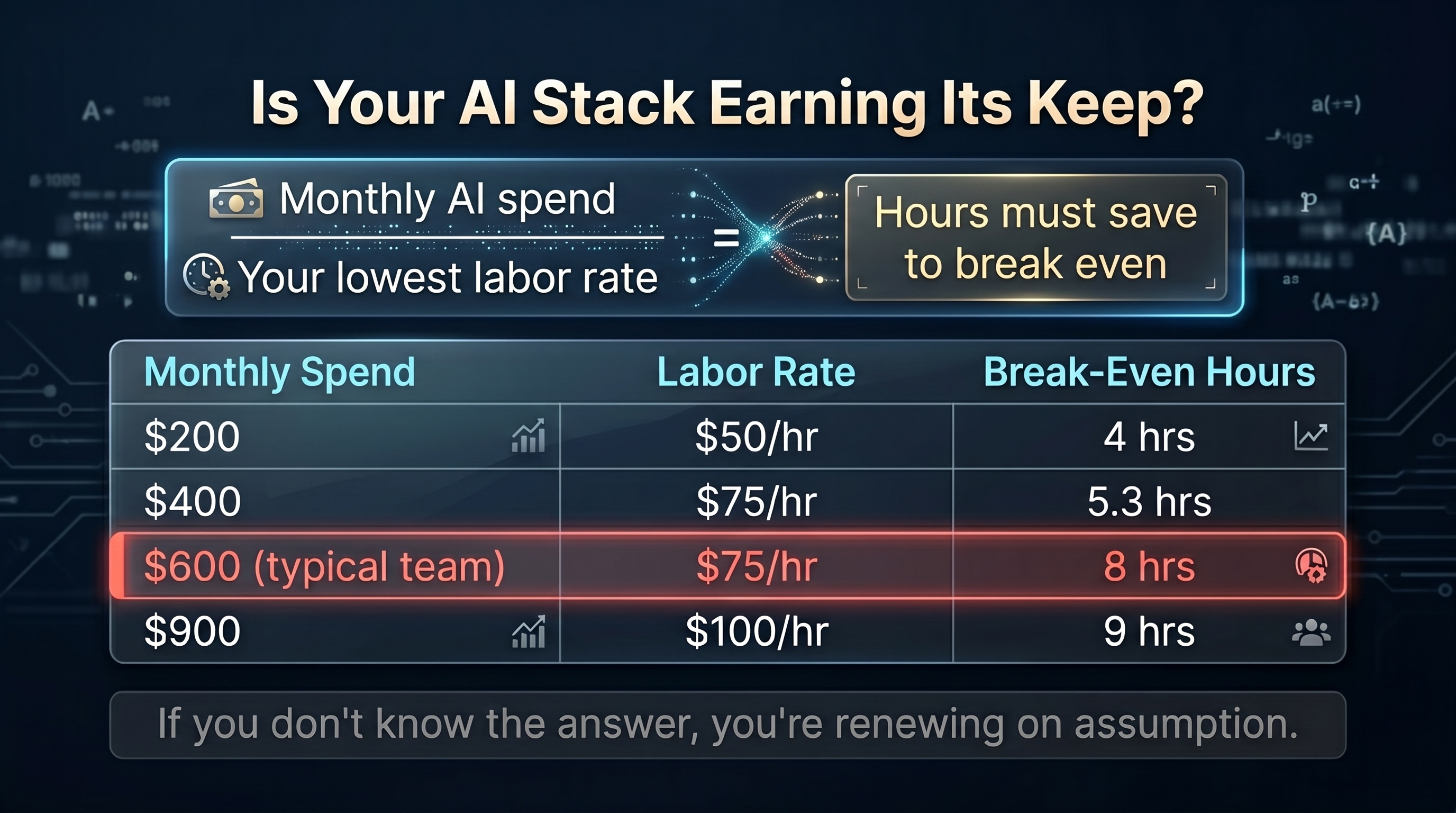
At $600 a month and a $75 labor rate, your AI stack needs to save at least eight hours per month to pay for itself. Before it can contribute to ROI, it has to clear that bar. Most teams don't know if it does.
The Nexairi Read
The accountability gap in AI spending is structural. Boards approved budgets because AI looked like a competitive necessity. Most CFOs accepted those budgets without demanding the governance framework that makes spending defensible. The result is the pattern IBM documented: real spending, no visibility, no measurement system and a renewal cycle that repeats without scrutiny.
The fix isn't to slow AI investment. It's to treat the next renewal cycle as a governance audit. Every active subscription should answer three questions before it renews: What workflow does it own? Who measures the result? What did that workflow cost before the tool existed? If those answers aren't available, put the tool on 60-day probation. Give it a defined window to produce a documented result. If it can't, cancel it before the next charge clears. The CFOs who close this gap won't be the ones spending the least on AI. They'll be the ones who built a short list of answers before the board asked.
What Should You Ask Before Your Next AI Renewal?
You don't need a formal governance program to start. Three honest questions, answered before each renewal date, are enough.
First: name the workflow this tool was hired to fix and estimate what it cost before you had it. If you can't do that, you have no baseline. You're renewing on assumption.
Second: name the person accountable for measuring the result. "The team that uses it" is not an owner. An owner has a name and a number they're responsible for hitting.
Third: if you pulled this tool from your stack tomorrow, what specifically would break? If nothing comes to mind, the tool isn't part of a workflow. It's a habit. And habits don't show up in ROI reports.
The usefulness of any AI tool is proportional to the clarity of the problem it was hired to solve. Most organizations skipped that conversation. The renewal cycle is a second chance to have it.
Sources
- Grant Thornton AI Governance Survey (April 2026) — via Axios coverage. 75% of boards approved AI; 48% set no governance expectations; 46% built no AI risk oversight.
- IBM C-Level Technology Survey (2026) — 85% lacked real-time AI spend visibility; 77% reported AI adoption outpacing governance.
- McKinsey Enterprise AI ROI Analysis (May 2026) via Business Insider — Top-performing teams got ~$3 back per $1 spent by focusing on 3 or fewer domains.
- KPMG 2026 Finance AI Survey — 74% of finance leaders reported AI ROI expectations met or exceeded; 64% cited lack of clear use cases as a hurdle.
- Deloitte CFO Signals Survey — 49% of CFOs cited data and technology resources as top barrier to AI scaling.
- Confluent Study — 72% of IT leaders cited poor real-time data infrastructure as a blocker to AI scaling.
Related Articles on Nexairi
Free Assessment
Is your firm ready for AI?
A 5-minute governance check for CPA firms using ChatGPT, Copilot or AI accounting software. Get your score and your top gaps — free.
Sydney Smart is a Certified Public Accountant, Fractional CFO, and Controller with over 17 years of experience across public accounting and corporate finance. She holds a Master's degree in Taxation from Georgia State University, is a licensed CPA through the Georgia Society of CPAs, and is a certified QuickBooks Pro Advisor. Sydney spent 13 years as a Senior Tax Manager at Hungeling CPA preparing and reviewing hundreds of tax returns annually for corporate, partnership, and individual clients before moving into corporate controller roles. As Founder of Simply Smart Consulting, she partners with founders and growth-focused businesses to build financial systems that scale — budgeting, cash flow forecasting, GAAP compliance, and real-time KPI reporting. She reviews Nexairi's accounting and finance coverage to ensure accuracy for the CPAs, CFOs, and operators who rely on it.