Elon's Interplanetary Stack — Series Overview
This is Part 2 of seven. Each part covers one layer of the integrated system Musk is building — from chips to robots to compute to launch to energy to Mars. The parts build on each other, but each stands alone. Open the full series hub.
- Part 1: TERAFAB — the silicon foundation
- Part 2 (You are here): Tesla Beyond Cars — Optimus robots and the FSD 2026 roadmap
- Part 3: xAI Colossus 2.0 — the world's largest AI supercomputer
- Part 4: Starship 2026 — SpaceX's launch revolution for Mars
- Part 5: Elon's Stack Has a Power Problem the Grid Can't Ignore
- Part 6: Elon's Mars vision — how robots, AI, and Starship make it real
- Part 7: Bold vision or impossible dream? A 2026 reality check
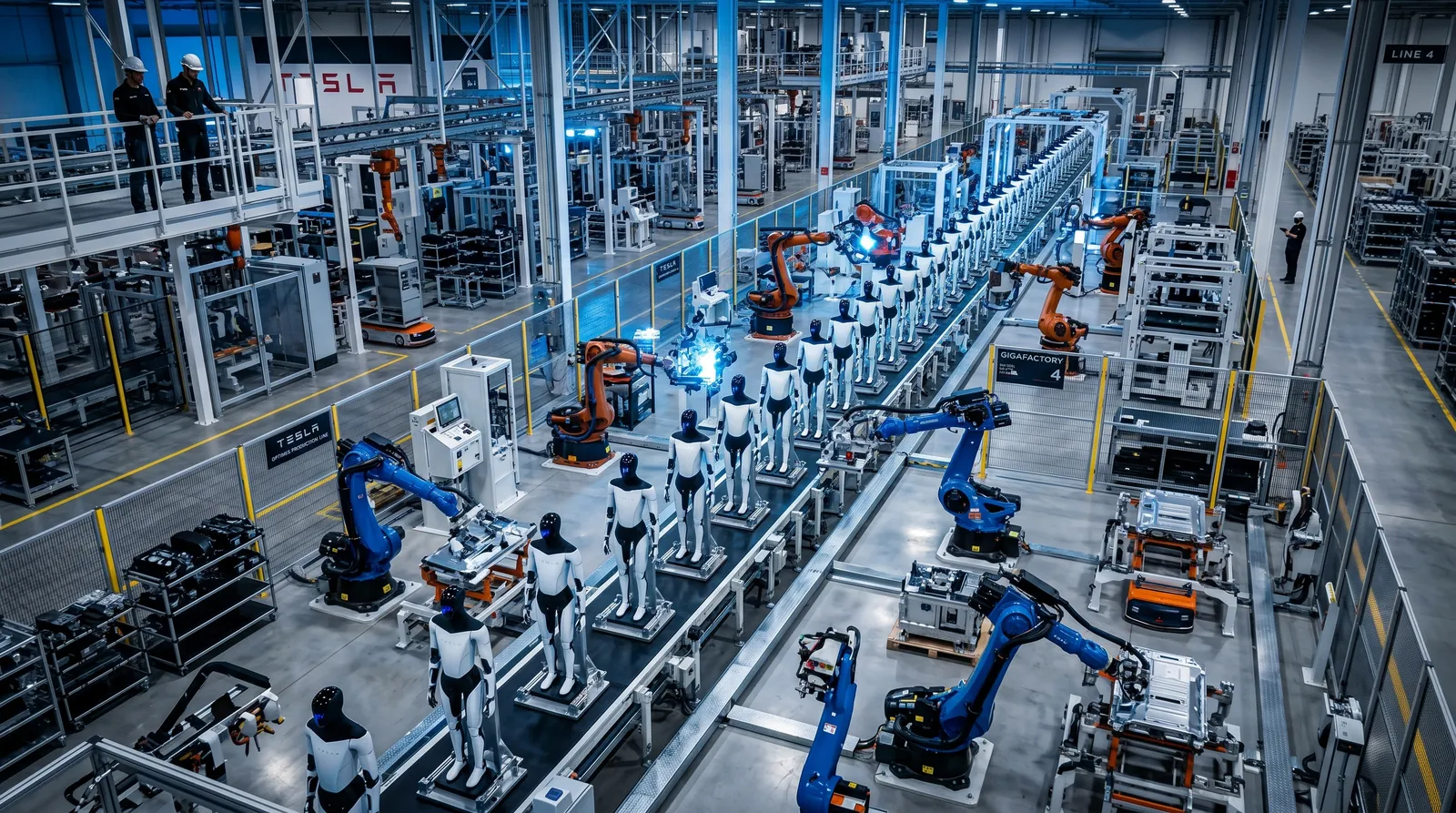
Tesla stopped making the Model S and X in early May 2026. The company built these cars for fourteen years. The Fremont production line that made them — one of the most precise manufacturing systems Tesla operates — went quiet for a few weeks, then started reassembly. The robots and tooling that built luxury sedans and SUVs are being replaced with equipment to build humanoid robots.
This is not a metaphor. Elon Musk confirmed during Tesla's Q1 2026 earnings call that Optimus production begins at Fremont in late July or August, per Electrek's Fred Lambert. The production line that once produced two of Tesla's highest-margin vehicles will now build walking machines with 10,000 unique parts that have never been manufactured at scale before. The conversion started in May. Production starts four months later. That is an extraordinarily compressed timeline for a product this new.
What is Optimus and why is it Tesla's most important product?
Optimus is Tesla's humanoid robot — designed to perform manual labor tasks, priced for eventual consumer sale at $20,000 or below, and built on the same AI platform that powers Full Self-Driving in Tesla vehicles.
Tesla has described Optimus as a general-purpose humanoid robot. The version currently in production — Optimus V2 — stands roughly 5'8", weighs 125 lbs, and is designed to perform tasks in environments built for humans: warehouses, factories, homes. Musk has cited a long-term target price of $20,000 at volume, which would make it comparable to a used car rather than a piece of industrial equipment.
The economics matter because they reframe what Tesla is. A robot that costs $20,000 at retail but performs the work of a $50,000-per-year employee has an obvious payback period. If Tesla can produce Optimus at scale — and the TERAFAB chip factory we covered in Part 1 is designed partly to supply the inference silicon each unit needs — the total addressable market is not the automotive market. It's global labor. Musk has said the number of Optimus units could eventually exceed the human population of Earth. That's a vision statement, not a production forecast. But it explains why Tesla's stock is valued the way it is even as EV deliveries flatline.
The Optimus platform connects directly to Tesla's FSD (Full Self-Driving) development. Both systems use neural network-based AI that processes camera input to understand and navigate a physical environment. The training infrastructure for FSD — the billions of miles of real-world driving data, the Dojo supercomputer, the upcoming xAI Colossus integration we'll cover in Part 3 — is also the training infrastructure for Optimus. Tesla isn't building two separate AI systems. It's building one AI platform and deploying it in multiple form factors.
When does Optimus V3 arrive and what will it do differently?
Optimus V3 has slipped to "later this year" — at least the third consecutive quarterly delay. No specs have been confirmed, but the current V2 is already performing factory tasks at Giga Texas.
The reveal of Optimus V3 was pushed again during the Q1 2026 earnings call, according to Electrek. This follows slips from Q4 2025 and Q1 2026. Tesla has not confirmed V3 specifications publicly. What is known is that V2 units are already working inside Giga Texas — performing tasks like moving parts, sorting components and carrying materials — and that the transition to Fremont production represents a significant production scale-up even on the current hardware generation.
The V3 delay matters because it signals that Tesla is choosing production volume over hardware iteration. Getting V2 into Fremont manufacturing is the priority. A V3 reveal without production capacity doesn't move the revenue needle. A V2 production ramp with thousands of units — even at "quite slow" initial volumes — starts building the data flywheel that makes each subsequent hardware generation better. That is the same logic Tesla applied to FSD: ship real hardware, collect real data, improve faster than labs running on simulations.
What makes Optimus's 10,000-part count significant is context: Tesla's other vehicles have been refined over years of production. The Model Y, which rolls off Fremont's other lines, benefits from years of supplier relationship, tooling maturity and defect analysis. Optimus has none of that history. Every part is new. Every tolerance is unproven at volume. That's why Musk called initial output "literally impossible to predict." He's not being falsely modest. He's describing a manufacturing engineering problem that has no recent precedent in consumer products.
| Capability Layer | FSD (vehicles) | Optimus (robots) |
|---|---|---|
| AI architecture | Neural net, camera-first perception | Same neural net base; adapted for locomotion + manipulation |
| Training data source | Billions of real-world driving miles | Factory task demonstrations + simulation |
| Inference hardware | HW4 chip (64GB total w/ Plus upgrade) | Custom silicon; TERAFAB chip target (Part 1) |
| Current autonomy status | Supervised (consumer); unsupervised fleet: 25 vehicles | Supervised factory tasks at Giga Texas |
| Production start | Cybercab: started at Giga Texas (Apr 2026) | Optimus V2: Fremont July–Aug 2026 |
| Target price | Cybercab: undisclosed; FSD subscription: $199/mo | $20,000 at volume (Musk long-term target) |
What is the real status of Tesla's Full Self-Driving in 2026?
FSD unsupervised for consumer vehicles is now Q4 2026 at the earliest. The Robotaxi fleet has 25 operational vehicles. Tesla is also proposing urban "microfactories" to retrofit millions of HW3 cars it said could do FSD — but can't.
Musk said during the Q1 2026 call that unsupervised FSD for consumer Teslas wouldn't arrive until Q4 2026 "at the earliest" — and even that came with a caveat. "I'm just guessing here, but probably in the fourth quarter," Musk said, per Electrek. This is the latest in a series of timeline revisions that now spans multiple years. FSD V13 shipped to consumers in late 2025, and V14 is rolling out now, but the jump from supervised to unsupervised — the version where the driver can sleep, legally — has repeatedly proven harder than projected.
The HW3 situation is the starkest illustration of how hard the problem has been. Tesla sold millions of vehicles with HW3 computers and marketed them with promises of future full autonomy capability. Musk confirmed again on the Q1 2026 call that HW3 "simply does not have the capability" for unsupervised FSD. Tesla's proposed solution, reported by Electrek's Jameson Dow, is to build urban "microfactories" that can retrofit these vehicles with HW4 hardware — replacing computers and cameras at scale. The cost and logistics of that program would be substantial for a company already projecting negative free cash flow for the remainder of 2026.
Meanwhile, Tesla announced that it would deliver an FSD V14 Lite version to HW3 vehicles in international markets — but only after the US rollout is complete, with no timeline attached. That announcement came, per Electrek, in response to open revolt from HW3 owners in Europe and other markets who were excluded from the FSD abroad launch, which went exclusively to HW4-equipped vehicles. The two-tier system — HW4 gets real FSD, HW3 gets a lite version at some point later — is a significant reframing of what Tesla promised when those cars were sold.
How far along is the Tesla Robotaxi program?
Cybercab production has started at Giga Texas, but the unsupervised Robotaxi fleet stands at just 25 vehicles across Austin, Dallas and Houston — a number far below what Musk had projected.
Musk confirmed that Cybercab production began at Giga Texas on the Q1 2026 earnings call. VP of Vehicle Engineering Lars Moravy added that the Cybercab won't be subject to NHTSA's 2,500-vehicle annual production cap for autonomous vehicles, per Electrek — a meaningful regulatory detail that removes one constraint on how fast Tesla can grow the fleet.
The current fleet, however, tells a different story. According to data from the Robotaxi Tracker cited by Electrek's Fred Lambert on April 30, Tesla's unsupervised Robotaxi fleet had grown to 25 cumulative vehicles across three Texas cities — Austin, Dallas and Houston. The Dallas and Houston expansions were announced April 24, the same day Tesla launched the Robotaxi app on Android, nearly a year after the iOS version. At 25 vehicles, the fleet is growing but remains operationally small. For context, Waymo operates hundreds of vehicles across multiple US cities and logged over 4 million rider trips in 2025.
Tesla has also, per Electrek's Jameson Dow, backpedaled on its commitment to launch Robotaxi service in five of the eight US cities it had previously announced availability in. The exact revised timeline wasn't specified during the earnings call, but the reduction in near-term city commitments suggests Tesla is managing expectations after the fleet ramp came in slower than projected.
The Robotaxi app arriving on Android a year after iOS is a small detail, but it fits a pattern. Tesla is deploying components of its autonomous vehicle program at a pace that doesn't match Musk's historical timelines — while simultaneously making the parts that will eventually matter at scale (Cybercab production, chip architecture, AI training infrastructure) more concrete. The question is whether the gap between the current 25-vehicle fleet and the millions of vehicles Musk describes closes at a pace that justifies Tesla's valuation.
How does the FSD hardware upgrade problem affect Tesla's business?
The HW3 retrofit issue represents a significant liability: millions of vehicles sold on autonomous driving promises now require hardware replacements Tesla hadn't planned to fund at this scale.
Tesla ended Q1 2026 with 1.28 million active FSD subscriptions — up 51% year-over-year, per TechCrunch. That number looks strong in isolation. But the context matters: if the subscribers driving HW3 vehicles eventually cannot access unsupervised FSD on their current hardware, that subscriber base either churns, demands refunds, or requires hardware upgrades that cost Tesla money per vehicle. None of those outcomes improves the FSD revenue trajectory that Tesla's current valuation depends on.
HW4 Plus — the upgraded self-driving computer Musk announced on the Q1 call, with doubled RAM from 16GB to 32GB per chip and 64GB total system memory — is already raising a parallel question. If HW3 is being made obsolete by HW4, what does HW4 Plus becoming the new standard mean for the HW4 vehicles on the road today? Electrek's Fred Lambert asked exactly this: will HW4 follow HW3 to the grave? Tesla hasn't answered directly. The pattern suggests the question is worth tracking closely.
Nexairi Analysis: The Production Bet Behind the Vision
The Q1 2026 earnings call revealed something important: Tesla is making a manufacturing bet on Optimus before it has solved the software problem on FSD. That's not a contradiction — it's a deliberate sequence. Get physical production infrastructure in place, then close the software gap. The logic holds if you believe the software problem is solvable and that manufacturing at scale is the harder constraint. If the software gap is the binding constraint, the sequence becomes painful.
The HW3 situation is the closest thing to a canary in the coal mine. Tesla made autonomous-driving promises it couldn't deliver on the hardware it shipped. Now it has to retrofit millions of vehicles or manage a class of customers who paid for something they can't have. The proposed microfactory solution is plausible in theory but hasn't been costed or committed to. It sits in the same category as many Musk announcements: directionally real, operationally undefined.
On Optimus, I think the correct frame is: Tesla is the only consumer company with a credible path to humanoid robots at volume. Boston Dynamics makes extraordinary machines but has never sold a consumer product. Figure and 1X are well-funded startups, not companies with Tesla's manufacturing infrastructure, supplier relationships, or retail distribution. If Optimus V2 production ramps even modestly at Fremont — say, a few thousand units in H2 2026 — Tesla will have a data and production advantage its competitors can't easily close. The question isn't whether Tesla can build robots. It's whether it can build them at the price and scale the thesis demands.
The chips from Part 1 connect directly to this. Optimus running on TERAFAB silicon at a cost that makes the $20,000 unit price viable is the integrated thesis. Part 1 was about why Tesla is building its own chip supply chain. Part 2 is about what happens if that works.
What does this mean for the rest of the interplanetary stack?
Optimus and FSD are Layer 2 of a seven-layer system. The robots need AI training at scale — which leads directly to Part 3: xAI Colossus 2.0 and the world's largest AI supercomputer in Memphis.
The TERAFAB chips we covered in Part 1 are the inference hardware layer — silicon that runs trained models inside each robot and vehicle. But training those models requires a different kind of infrastructure entirely: massive compute clusters running for months on huge datasets. Tesla has Dojo, its custom training supercomputer. But xAI has Colossus — currently the largest AI training cluster on the planet at 200,000 GPUs and growing toward 555,000, per public announcements from Musk. The relationship between the models trained in Memphis and the robots deployed from Fremont is direct and operational.
In January 2026, Tesla invested $2 billion in xAI specifically "to enhance Tesla's ability to develop and deploy AI products and services in the physical world at scale," per The Verge. That phrase — "in the physical world at scale" — maps precisely onto what Optimus is trying to do. The investment is not a financial bet on a separate company. It's a supply chain agreement for training compute. The robots built in Fremont run intelligence trained in Memphis. Part 3 covers what that actually looks like.
Next week: xAI Colossus 2.0 — the world's largest AI supercomputer at 555,000 GPUs, and the training infrastructure behind both Grok and Optimus. Part 3 publishes Thursday, May 7.
Sources
- Electrek — Tesla pushes Optimus V3 reveal later this year; production at Fremont July–Aug (Fred Lambert, April 22, 2026)
- Electrek — Elon Musk pushes unsupervised FSD for consumer Teslas — again (Fred Lambert, April 22, 2026)
- Electrek — Tesla will build factories just to retrofit millions of HW3 cars it said could do FSD (Jameson Dow, April 22, 2026)
- Electrek — Tesla announces HW4 Plus with doubled memory — will HW4 follow HW3 to the grave? (Fred Lambert, April 23, 2026)
- Electrek — Tesla confirms Cybercab production has started despite delays in unsupervised driving (Fred Lambert, April 23, 2026)
- Electrek — Tesla Robotaxi unsupervised fleet finally shows some signs of ramping up (Fred Lambert, April 30, 2026)
- Electrek — Tesla finally launches Robotaxi app on Android, nearly a year after iOS (Fred Lambert, April 27, 2026)
- Electrek — Tesla promises FSD V14 Lite for HW3 cars internationally to appease growing tensions (Fred Lambert, April 28, 2026)
- Electrek — Tesla seems to say Robotaxi launch will be pushed back in 5 US cities (Jameson Dow, April 22, 2026)
- TechCrunch — Tesla Q1 revenue rises, driven by EV sales and FSD subscriptions (Kirsten Korosec and Sean O'Kane, April 22, 2026)
- The Verge — Tesla invested $2 billion in xAI to enable AI in the physical world (January 28, 2026)
Related Articles on Nexairi
- Full series: Elon's Interplanetary Stack
- Part 1: TERAFAB — Tesla's Secret Weapon for AI Chip Dominance in 2026
- Part 3: xAI Colossus — 555,000 GPU Supercomputer in Memphis
- Part 4: Starship 2026 — SpaceX's Launch Revolution for Mars
- Part 5: Elon's Stack Has a Power Problem the Grid Can't Ignore
- SpaceX Acquires xAI in a $1.25 Trillion Deal — What It Actually Means
Jim Smart is the founder and editor in chief of Nexairi. A Business Intelligence Developer with experience building data systems for Verizon, U.S. Army operations, and enterprise finance teams, Jim spent years turning complex data into decisions that executives could act on — dashboards, forecasting models, and automation pipelines across telecom and government contracting. He founded Nexairi to apply that same clarity to AI: making emerging technology understandable and actionable for the operators, accountants, and business owners who need it most. Jim holds GenAI certifications from the University of South Florida Bellini College of AI and completed Springboard's Data Science Career Track.