
Last year, 33 out of every 100 tax practitioners used AI to research a client question. Today, 60 out of 100 do.
That's not a slow shift. Something tipped.
And it tipped right into the middle of hourly billing — the model almost every accounting firm still uses to charge for research work.
A new survey of 1,000 U.S. tax professionals by Blue J and CPA.com found that 84% say AI saves them meaningful time. It also found that 69% are planning to change how they bill clients because of it. Almost none have a concrete model to replace hourly billing yet.
The technology moved fast. The invoice didn't.
Why Did AI Use in Tax Research Nearly Double in One Year?
In March 2026, Blue J and CPA.com surveyed 1,000 U.S. tax professionals. They asked whether each person used AI to help with tax research. Sixty percent said yes.
One year earlier, that number was 33%.
A 27-point jump in 12 months is rare in any profession. The firms that moved early are now doing research differently. The firms that haven't are billing for time their peers stopped spending.
The survey covered practitioners who do tax research at least a few times a year. That includes solo CPAs and large firm staff alike. The jump held across firm sizes.
What drove the shift? Speed and access. AI can surface relevant tax code, case law and guidance in minutes. A question that used to require a senior staff member's full morning can now be answered before lunch — by a junior associate with the right tool.
That's a real change. It's also a billing problem that most firms haven't solved yet.
If AI Saves Research Time, Why Hasn't the Invoice Changed?
The Blue J / CPA.com survey asked practitioners why they use AI for research. The most common answer: it saves time. Eighty-four percent cited meaningful time savings.
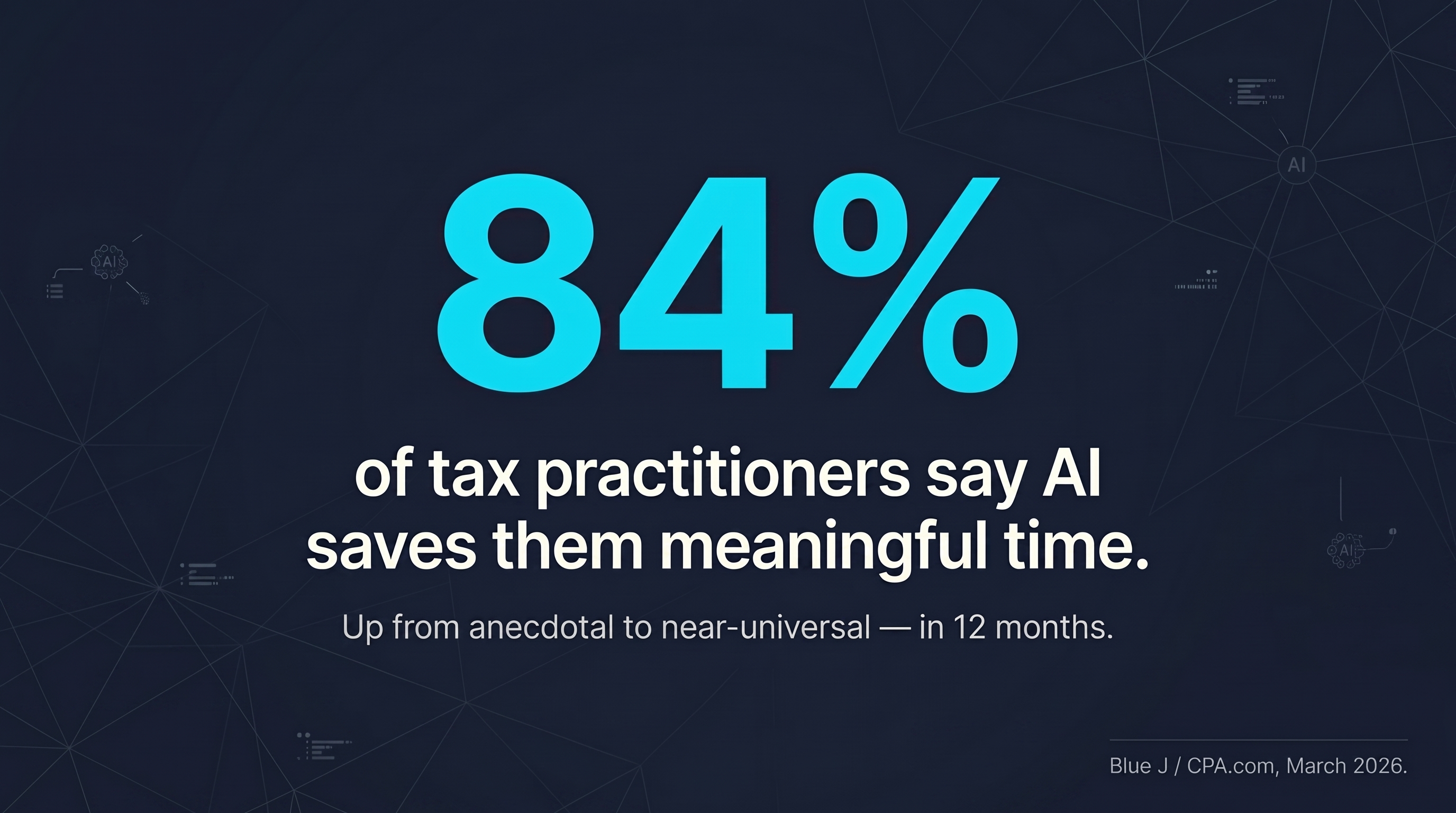
Eighty-four percent is close to universal. But saving time and knowing what to charge for that time are two separate problems.
Think about a complex client question. Before AI, it might take a full morning to research — pulling statutes, reviewing cases, checking guidance. Now AI does the first pass in minutes. A senior person reviews, edits and signs off. The client gets the same defensible answer. The work took far less time.
But the invoice still reflects hours logged.
This is where the hourly billing model starts to crack. The work is faster. The work product is the same. The price signal is wrong — and someone will eventually notice.
Some clients won't ask right away. But as AI becomes standard in accounting firms, the gap between time spent and value delivered gets harder to hide. A client who finds out their research invoice reflects hours an AI resolved in 20 minutes will have questions. Better to shape that conversation before they start it.
69% Plan to Change Their Billing. Most Don't Have a New Model Yet.
The Blue J / CPA.com survey found that 69% of tax practitioners plan to change their billing model because of AI. That's a large majority of the profession moving in the same direction.
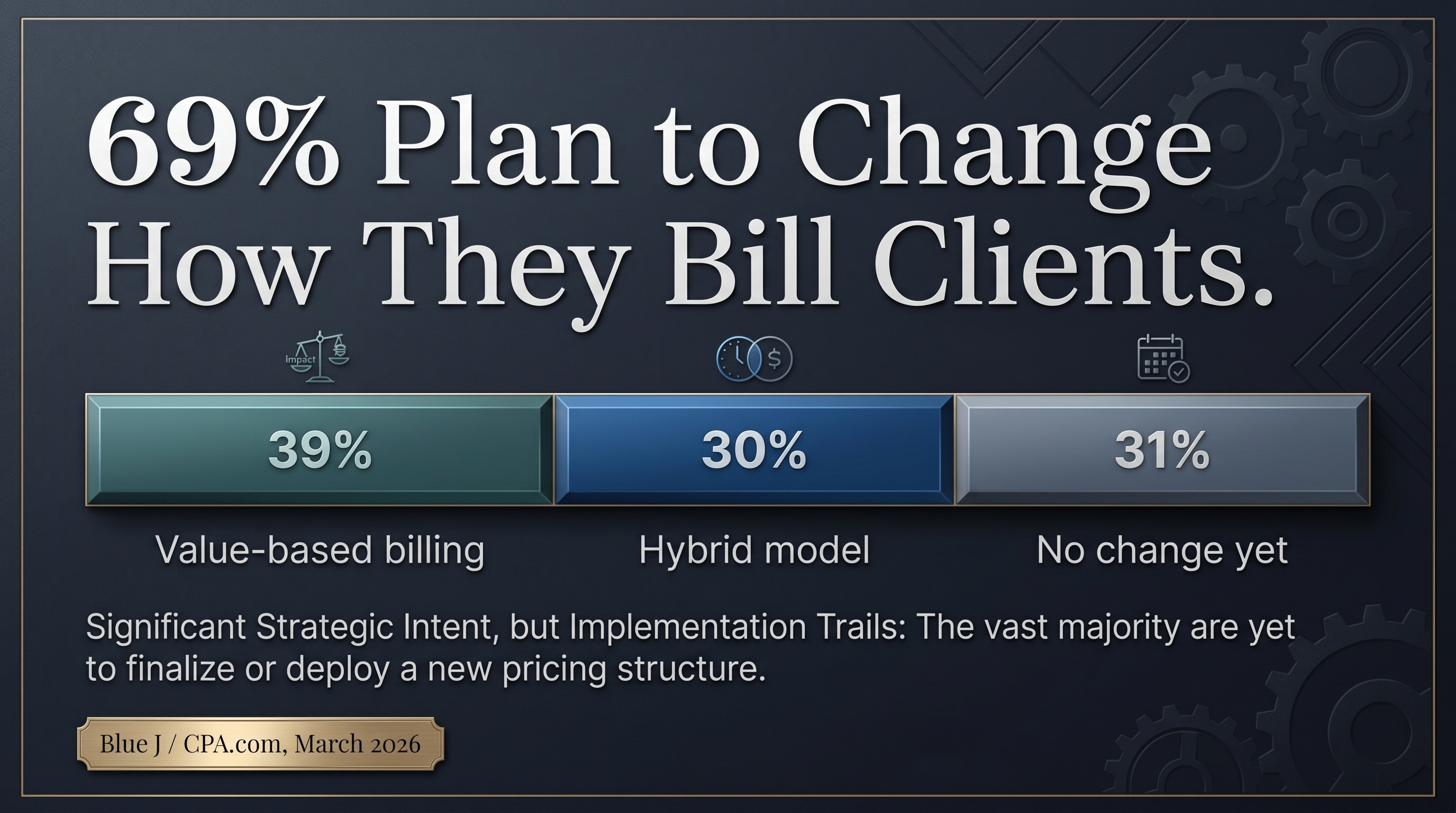
Here's where they're leaning:
- 37% toward value-based billing — charging for the outcome, not the hours
- 30% toward a hybrid model — part fixed fee, part hourly
Both are real paths forward. But Accounting Today, which covered the survey on June 9, 2026, noted that almost none of these firms have actually built a new billing model yet. The intention is there. The pricing architecture isn't.
| Billing Approach | What You Charge For | Fits Best When |
|---|---|---|
| Hourly | Time spent per task | Variable projects, new clients, unpredictable scope |
| Value-based | The outcome and its worth to the client | Tax positions, planning with clear ROI |
| Fixed fee | A defined scope of work | Recurring services, predictable tasks |
| Hybrid | A mix of the above | Transitioning firms, mixed client types |
Value-based billing means charging for what you know and what the answer is worth. A tax position that protects a client from a six-figure exposure has a value. A question resolved correctly in a fraction of the time it used to take has a value. Hourly billing doesn't capture either of those well.
Fixed fees and subscriptions are another option. But they require a different kind of client conversation. You're not tracking hours after the fact. You're pricing by scope in advance. That's a workflow change inside the firm and a different contract with the client.
Neither change is easy to make mid-engagement. That's why 69% have signaled intent but most haven't moved.
Is Your AI-Assisted Work Audit-Ready?
KPMG surveyed 1,013 senior finance leaders globally in May 2026. The finding that matters most for accounting practitioners isn't the adoption rate.
It's this: 58% of finance organizations are not fully "assurance-ready" for AI.
KPMG defines assurance-ready as being able to produce audit evidence and explain how AI-driven decisions were reached. That's a standard with legal and regulatory weight — not just a best practice.
If your firm uses AI in tax positions, financial analysis or close process support, can you show how the AI got there? If an auditor or peer reviewer asks, can you trace the decision back to a source?
KPMG's survey covered organizations with at least $250 million in revenue. These are large enterprise finance teams, not small CPA firms. But the question their auditors are asking will reach smaller practices through two paths.
First: if your firm produces audit-adjacent work — financial statements, tax positions or close process support — your clients' auditors may eventually ask about any AI that touched those numbers. Second: if your firm undergoes a peer review or quality inspection, your AI use will be in scope.
The assurance gap is also a billing opportunity. Firms that can document how AI-assisted work was reviewed and verified can offer that documentation as part of their value. Firms that can't will face questions they're not ready for.
Nexairi covered the full KPMG assurance picture in Most Companies Use AI in Finance. Most Can't Audit It.
What to Decide Before Your Next Client Renewal
The billing problem is not abstract. If you're renewing client retainers before year-end, you need working answers before those conversations start.
Start with your fee structure. If AI cut the time on a recurring research task by half, and your invoice reflects the old time, something is off. Either you're underpricing the value — the answer is worth the same regardless of how long it took — or you're effectively charging for efficiency gains the client didn't see. Both are positions you need to be able to defend before a client asks.
Then decide how to talk about it. "We use AI and it's faster" is not a client conversation. "We deliver the same quality answer with fewer revision cycles, and our fee reflects what that's worth" is. The value framing has to come before the price change.
Finally, check your paper trail. If AI helped with any part of client-facing work this year, do you have a record of what it produced and how it was reviewed? That review log is what separates defensible AI use from a liability. It's also what you'd need if a peer review or auditor ever asked.
The 69% planning to change their billing model have the right instinct. The firms that do it well will tie the change to documented value and a documented review process — not just to the time they saved.
The survey found 69% of practitioners are ready to change something. That's a healthy signal. The profession sees what AI is doing to the economics of research work. The hard part isn't the intent. It's building the new model before a client conversation forces it.
For a broader look at how AI adoption is reshaping accounting firm strategy, see GenAI Adoption in Accounting Tripled in Two Years. The Strategy Gap Is Now the Real Risk. If you're still working out how to measure whether AI is actually helping your firm, Your Firm's AI Adoption Metric Is Probably Broken is the right starting point.
Sources
- Accounting Today — Tax research AI usage doubles, more considering alternative billing models (June 9, 2026)
- CPA Practice Advisor — Blue J and CPA.com Survey: AI Adoption Among Tax Firms Has Nearly Doubled (June 2, 2026)
- KPMG — 2026 Global AI in Finance: The Decision Advantage (May 2026)
- McKinsey — AI in finance: Driving automation and business value (November 2025)
- Bloomberg Tax — AI Efficiency Gains Push Accounting Firms to Reimagine Pricing
Related Articles on Nexairi
Free Assessment
Is your firm ready for AI?
A 5-minute governance check for CPA firms using ChatGPT, Copilot or AI accounting software. Get your score and your top gaps — free.
Sydney Smart is a Certified Public Accountant, Fractional CFO, and Controller with over 17 years of experience across public accounting and corporate finance. She holds a Master's degree in Taxation from Georgia State University, is a licensed CPA through the Georgia Society of CPAs, and is a certified QuickBooks Pro Advisor. Sydney spent 13 years as a Senior Tax Manager at Hungeling CPA preparing and reviewing hundreds of tax returns annually for corporate, partnership, and individual clients before moving into corporate controller roles. As Founder of Simply Smart Consulting, she partners with founders and growth-focused businesses to build financial systems that scale — budgeting, cash flow forecasting, GAAP compliance, and real-time KPI reporting. She reviews Nexairi's accounting and finance coverage to ensure accuracy for the CPAs, CFOs, and operators who rely on it.